F1 racing lover John LePore (whose VFX work you’ve seen in Iron Man 2 and myriad other productions over the years) has created the first demo for Apple Vision Pro that makes me say, “Okay, dang, that looks truly useful & compelling.” Check out his quick demo & behind-the-scenes narration:
Apple Vision Pro + Formula 1 = Killer App (?)
a story about: -design & innovation -racing royalty -property theft and more! pic.twitter.com/6MbLKEDqOB
Hey gang—here’s to having a great 2024 of making the world more beautiful & fun. Here’s a little 3D creation (with processing courtesy of Luma Labs) made from some New Year’s Eve drone footage I captured at Gaviota State Beach. (If it’s not loading for some reason, you can see a video version in this tweet).
Oh look, I’m George Clooney! Kinda. You can be, too. FAL AI promises “AI inference faster than you can type.”
“100ms image generation at 1024×1024. Announcing Segmind-Vega and Segmind-VegaRT, the fastest and smallest, open source models for image generation at the highest resolution.”
Krea has announced their open beta, “free for everyone.”
Instagram has enabled image generation inside chat (pretty “meh,” in my experience so far), and in stories creation, “It allows you to replace a background of an image into whatever AI generated image you’d like.”
“Did you know that you can train an AI Art model and get paid every time someone uses it? That’s Generaitiv’s Model Royalties System for you.”
Here’s a great look at how the scrappy team behind Luma.ai has helped enable beautiful volumetric captures of Phoenix Suns players soaring through the air:
Go behind the scenes of the innovative collaboration between Profectum Media and the Phoenix Suns to discover how we overcame technological and creative challenges to produce the first 3D bullet time neural radiance field NeRF effect in a major sports NBA arena video. This involved not just custom-building a 48 GoPro multi-cam volumetric rig but also integrating advanced AI tools from Luma AI to capture athletes in stunning, frozen-in-time 3D visual sequences. This venture is more than just a glimpse behind the scenes – it’s a peek into the evolving world of sports entertainment and the future of spatial capture.
Man, I’m inspired—and TBH a little jealous—seeing 14yo creator Preston Mutanga creating amazing 3D animations, as he’s apparently been doing for fully half his life. I think you’ll enjoy the short talk he gave covering his passions:
The presentation will take the audience on a journey, a journey across the Spider-Verse where a self-taught, young, talented 14-year-old kid used Blender, to create high-quality LEGO animations of movie trailers. Through the use of social media, this young artist’s passion and skill caught the attention of Hollywood producers, leading to a life-changing invitation to animate in a new Hollywood movie.
That’s the promise of Adobe’s Project Neo—which you can sign up to test & use now! Check out the awesome sneak peek they presented at MAX:
Incorporating 3D elements into 2D designs (infographics, posters, logos or even websites) can be difficult to master, and often requires designers to learn new workflows or technical skills.
Project Neo enables designers to create 2D content by using 3D shapes without having to learn traditional 3D creation tools and methods. This technology leverages the best of 3D principles so designers can create 2D shapes with one, two or three-point perspectives easily and quickly. Designers using this technology are also able to collaborate with their stakeholders and make edits to mockups at the vector level so they can quickly make changes to projects.
Roughly 1,000 years ago (i.e. this past April!), I gave an early sneak peek at the 3D-to-image work we’ve been doing around Firefly. Now at MAX, my teammate Yi Zhou has demonstrated some additional ways we could put the core tech to work—by adding posable humans to the scene.
Project Poseable makes it easy for anyone to quickly design 3D prototypes and storyboards in minutes with generative AI.
Instead of having to spend time editing the details of a scene — the background, different angles and poses of individual characters, or the way the character interacts with surrounding objects in the scene — users can tap into AI-based character posing models and use image generation models to easily render 3D character scenes.
I’m so pleased & even proud (having at least having offered my encouragement to him over the years) to see my buddy Bilawal spreading his wings and spreading the good word about AI-powered creativity.
Check out his quick thoughts on “Channel-surfing realities layered on top of the real world,” “3D screenshots for the real world,” and more:
Favorite quote 😉:
“All they need to do is have a creative vision, and a Nack for working in concert with these AI models”—beautifully said, my friend! 🙏😜. pic.twitter.com/f6oUNSQXul
I love seeing Michael Tanzillo‘s Illustrator 3D -> Adobe Stager -> Photoshop workflow for making and enhancing the adorable “Little Miss Sparkle Bao Bao”:
With Sketch mode, we’re introducing a new palette of tools and guides that let you start taking control of your skybox generations. Want a castle in the distance? Sketch it out, specify a castle in your prompt and hit generate to watch as your scribbles influence your skybox. If you don’t get what you want the first time, your sketch sticks around to try a new style or prompt from – or switch to Remix mode to give that castle a new look!
I had a ball presenting Firefly during this past week’s Adobe Live session. I showed off the new Recolor Vectors feature, and my teammate Samantha showed how to put it to practical use (along with image generation) as part of a moodboarding exercise. I think you’d dig the whole session, if you’ve got time.
The highlight for me was the chance to give an early preview of the 3D-to-image creation module we have in development:
I’m really excited to see what kinds of images, not to mention videos & textured 3D assets, people will now be able to generate via emerging techniques (depth2img, ControlNet, etc.):
My friend Bilawal Sidhu made a 3D scan of his parents’ home (y’know, as one does), and he recently used the new ControlNet functionality in Stable Diffusion to restyle it on the fly. Check out details in this post & in the vid below:
To Sébastien Deguy and Christophe Soum for the concept and original implementation of Substance Engine, and to Sylvain Paris and Nicolas Wirrmann for the design and engineering of Substance Designer.
Adobe Substance 3D Designer provides artists with a flexible and efficient procedural workflow for designing complex textures. Its sophisticated and art-directable pattern generators, intuitive design, and renderer-agnostic architecture have led to widespread adoption in motion picture visual effects and animation.
I’m still digging out (of email, Slack, and photos, but thankfully no longer of literal snow) following last weekend’s amazing photo adventure in Ely, NV. I need to try processing more footage via the amazing Luma app, but for now here’s a cool 3D version of the Nevada Northern Railway‘s water tower, made simply by orbiting it with my drone & uploading the footage:
Unleash the power of photogrammetry in Adobe Substance 3D Sampler 4.0 with the new 3D Capture tool! Create accurate and detailed 3D models of real-world objects with ease. Simply drag and drop a series of photos into Sampler and let it automatically extract the subject from its background and generate a 3D textured model. It’s a fast and handy way to create 3D assets for your next project.
Last month Paul Trillo shared some wild visualizations he made by walking around Michelangelo’s David, then synthesizing 3D NeRF data. Now he’s upped the ante with captures from the Louvre:
NeRFs of the Louvre made from a handful of short iPhone videos shot during a location scout last month. Each shot reimagined over a month later. The impossibilities are endless. More to come…
Here’s an example made from a quick capture I did of my friend (nothing special, but amazing what one can get simply by walking in a circle while recording video):
As luck (?) would have it, the commercial dropped on the third anniversary of my former teammate Jon Barron & collaborators bringing NeRFs into existence:
Three years ago today, the project that eventually became NeRF started working (positional encoding was the missing piece that got us from "hmm" to "wow"). Here's a snippet of that email thread between Matt Tancik, @_pratul_, @BenMildenhall, and me. Happy birthday NeRF! pic.twitter.com/UtuQpWsOt4
Check out these gloriously detailed renderings from Markos Kay. I just wish the pacing were a little more chill so I could stare longer at each composition!
Kay has focused on the intersection of art and science in his practice, utilizing digital tools to visualize biological or primordial phenomena. “aBiogenesis” focuses a microscopic lens on imagined protocells, vesicles, and primordial foam that twists and oscillates in various forms.
The artist has prints available for sale in his shop, and you can find more work on his website and Behance.
1. Take reference photo (you can use any photo – e.g. your real house, it doesn’t have to be dollhouse furniture) 2. Set up Stable Diffusion Depth-to-Image (google “Install Stable Diffusion Depth to Image YouTube”) 3. Upload your photo and then type in your prompts to remix the image
We recommend starting with simple prompts, and then progressively adding extra adjectives to get the desired look and feel. Using this method, @justinlv generated hundreds of options, and then we went through and cherrypicked our favorites for this video
This stuff—creating 3D neural models from simple video captures—continues to blow my mind. First up is Paul Trillo visiting the David:
Finally got to see Michaelangelo's David in Florence and rather than just take a photo like normal person, I spent 20 minutes walking around it capturing every angle looking like an insane person. It's hard to look cool when making a #NeRF but damn it looks cool later @LumaLabsAIpic.twitter.com/sLGJ2CKCJy
Numerous apps are promising pure text-to-geometry synthesis, as Luma AI shows here:
✨ Introducing Imagine 3D: a new way to create 3D with text! Our mission is to build the next generation of 3D and Imagine will be a big part of it. Today Imagine is in early access and as we improve we will bring it to everyone https://t.co/VIdilw7kpapic.twitter.com/v6Yi0mwZsY
On a more immediately applicable front, though, artists are finding ways to create 3D (or at least “two-and-a-half-D”) imagery right from the output of apps like Midjourney. Here’s a quick demo using Blender:
In a semi-related vein, I used CapCut to animate a tongue-in-cheek self portrait from my friend Bilawal:
It’s insane to me how much these emerging tools democratize storytelling idioms—and then take them far beyond previous limits. Recently Karen X. Cheng & co. created some wild “drone” footage simply by capturing handheld footage with a smartphone:
Now they’re creating an amazing dolly zoom effect, again using just a phone. (Click through to the thread if you’d like details on how the footage was (very simply) captured.)
NeRF update: Dollyzoom is now possible using @LumaLabsAI I shot this on my phone. NeRF is gonna empower so many people to get cinematic level shots Tutorial below –
Last year my friend Bilawal Singh Sidhu, a PM driving 3D experiences for Google Maps/Earth, created an amazing 3D render (also available in galactic core form) of me sitting atop the Trona Pinnacles. At that time he used “traditional” photogrammetry techniques (kind of a funny thing to say about an emerging field that remains new to the world), and this year he tried processing the same footage (comprised of a couple simple orbits from my drone) using new Neural Radiance Field (“NeRF”) tech:
The 3D and Immersive Design Team at Adobe is looking for a design intern who will help envision and build the future of Adobe’s 3D and MR creative tools.
With the Adobe Substance 3D Collection and Adobe Aero, we’re making big moves in 3D, but it is still early days! This is a huge opportunity space to shape the future of 3D and AR at Adobe. We believe that tools shape our world, and by building the tools that power 3D creativity we can have an outsized impact on our world.
Easy placement/movement of 3D primitives -> realistic/illustrative rendering has long struck me as extremely promising. Using tech like StyleGAN to render from 3D can produce interesting results, but it’s been difficult to bring the level of quality & consistency up to what Adobe users demand.
Now with Stable Diffusion (and, one hopes, other diffusion models in the future) attached to Blender (and, one hopes, other object manipulation tools), the vision is getting closer to reality:
The power & immersiveness of rendering 3D from images is growing at an extraordinary rate. NeRF Studio promises to make creation much more approachable:
Depending on how well it works, tech like this could be the greatest unlock in 3D creation the world has ever known.
The company blog post features interesting, promising details:
Though quicker than manual methods, prior 3D generative AI models were limited in the level of detail they could produce. Even recent inverse rendering methods can only generate 3D objects based on 2D images taken from various angles, requiring developers to build one 3D shape at a time.
GET3D can instead churn out some 20 shapes a second when running inference on a single NVIDIA GPU — working like a generative adversarial network for 2D images, while generating 3D objects. […]
GET3D gets its name from its ability to Generate Explicit Textured 3D meshes — meaning that the shapes it creates are in the form of a triangle mesh, like a papier-mâché model, covered with a textured material. This lets users easily import the objects into game engines, 3D modelers and film renderers — and edit them.
See also Dream Fields (mentioned previously) from Google:
Great to see my old teammates (with whom I was working to enable cloud-rendered as well as locally rendered 3D experiences) continuing their work.
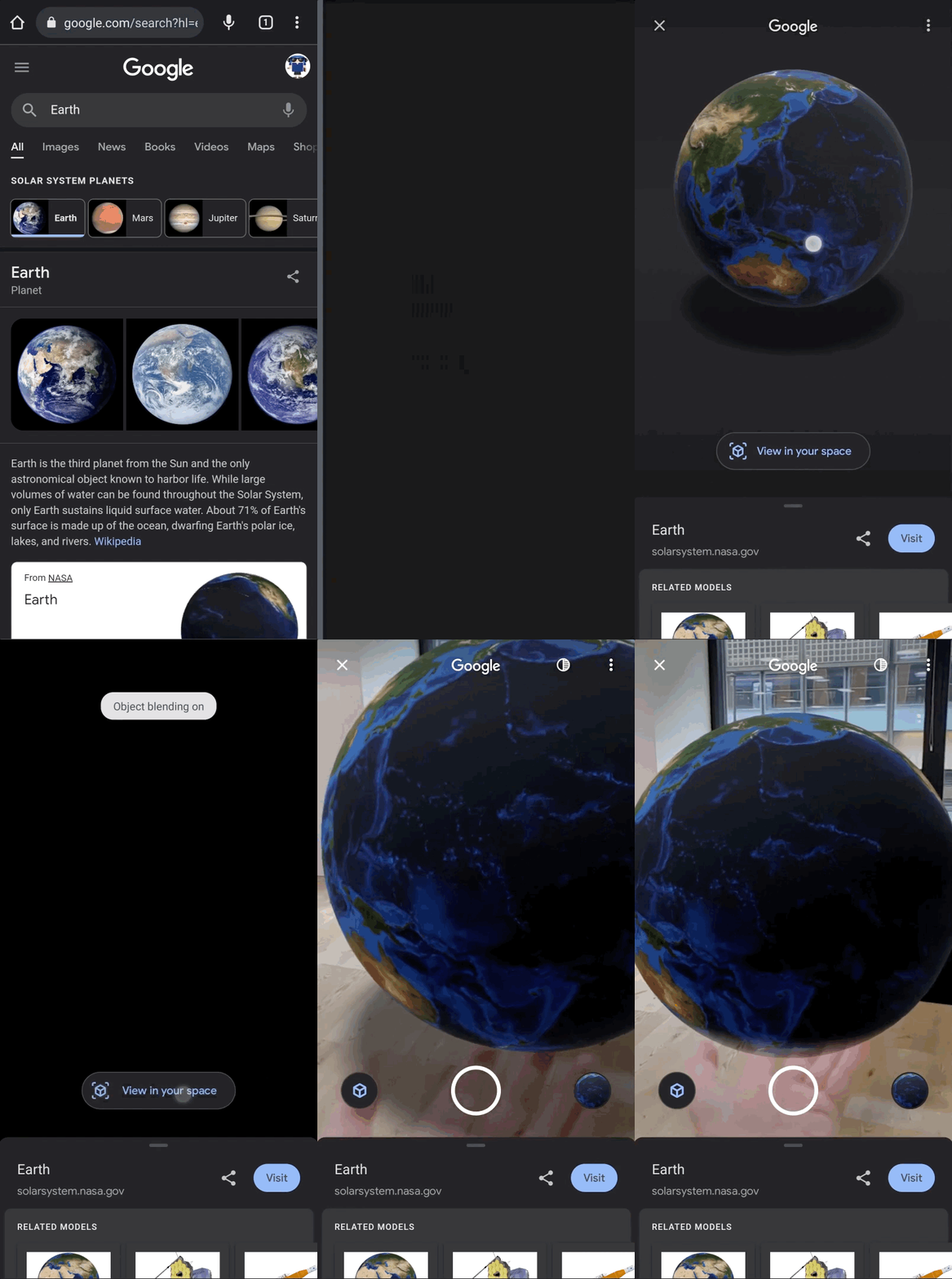
NASA and Google Arts & Culture have partnered to bring more than 60 3D models of planets, moons and NASA spacecraft to Google Search. When you use Google Search to learn about these topics, just click on the View in 3D button to understand the different elements of what you’re looking at even better. These 3D annotations will also be available for cells, biological concepts (like skeletal systems), and other educational models on Search.
After seeing years & years of AR demos featuring the placement of furniture, I once heard someone say in exasperation, “Bro… how much furniture do you think I buy?”
Happily here’s a decidedly fresh approach, surrounding the user & some real-world furniture with a projection of the person’s 3D-scanned home. Wild!
Now, how easy can 3D home scanning be made—and how much do people care about this kind of scenario? I don’t know, but I love what the tech can enable already.
Hmm—this is no doubt brilliant tech, and I’d like to learn more, but I wonder about the Venn diagram between “Objects that people want in 3D,” “Objects for which a sufficiently large number of good images exist,” and “Objects for which good human-made 3D models don’t already exist.” In my experience photogrammetry is most relevant for making models from extremely specific subjects (e.g. a particular apartment) rather than from common objects that are likely to exist on Sketchfab et al. It’s entirely possible I’m missing a nuanced application here, though. As I say, cool tech!
[W]e’re bringing photorealistic aerial views of nearly 100 of the world’s most popular landmarks in cities like Barcelona, London, New York, San Francisco and Tokyo right to Google Maps. This is the first step toward launching immersive view — an experience that pairs AI with billions of high definition Street View, satellite and aerial imagery.
Say you’re planning a trip to New York. With this update, you can get a sense for what the Empire State Building is like up close so you can decide whether or not you want to add it to your trip itinerary. To see an aerial view wherever they’re available, search for a landmark in Google Maps and head to the Photos section.
AI animation tech, which in this case leverages the motion of a face in a video to animate a different face in a still image, keeps getting better & better. Check out these results from Samsung Labs: