Real or AI rendered? Who even knows anymore, but either way these depictions are super well done. They even got the triumphal Riley Mills stomp!
View this post on Instagram
[Via Chris Davis]
Real or AI rendered? Who even knows anymore, but either way these depictions are super well done. They even got the triumphal Riley Mills stomp!
View this post on Instagram
[Via Chris Davis]
Having gotten my start in Flash 2.0 (!), and having joined Adobe in 2000 specifically to make a Flash/SVG authoring tool that didn’t make me want to walk into the ocean, I felt my cold, ancient Grinch-heart grow three sizes listening to Guido and Luigi Rosso—the brother founders behind Rive—on the School of Motion podcast:
[They] dig into what makes this platform different, where it’s headed, and why teams at Spotify, Duolingo, and LinkedIn are building entire interactive experiences with it!
Here’s a NotebookLM-made visualization of the key ideas:
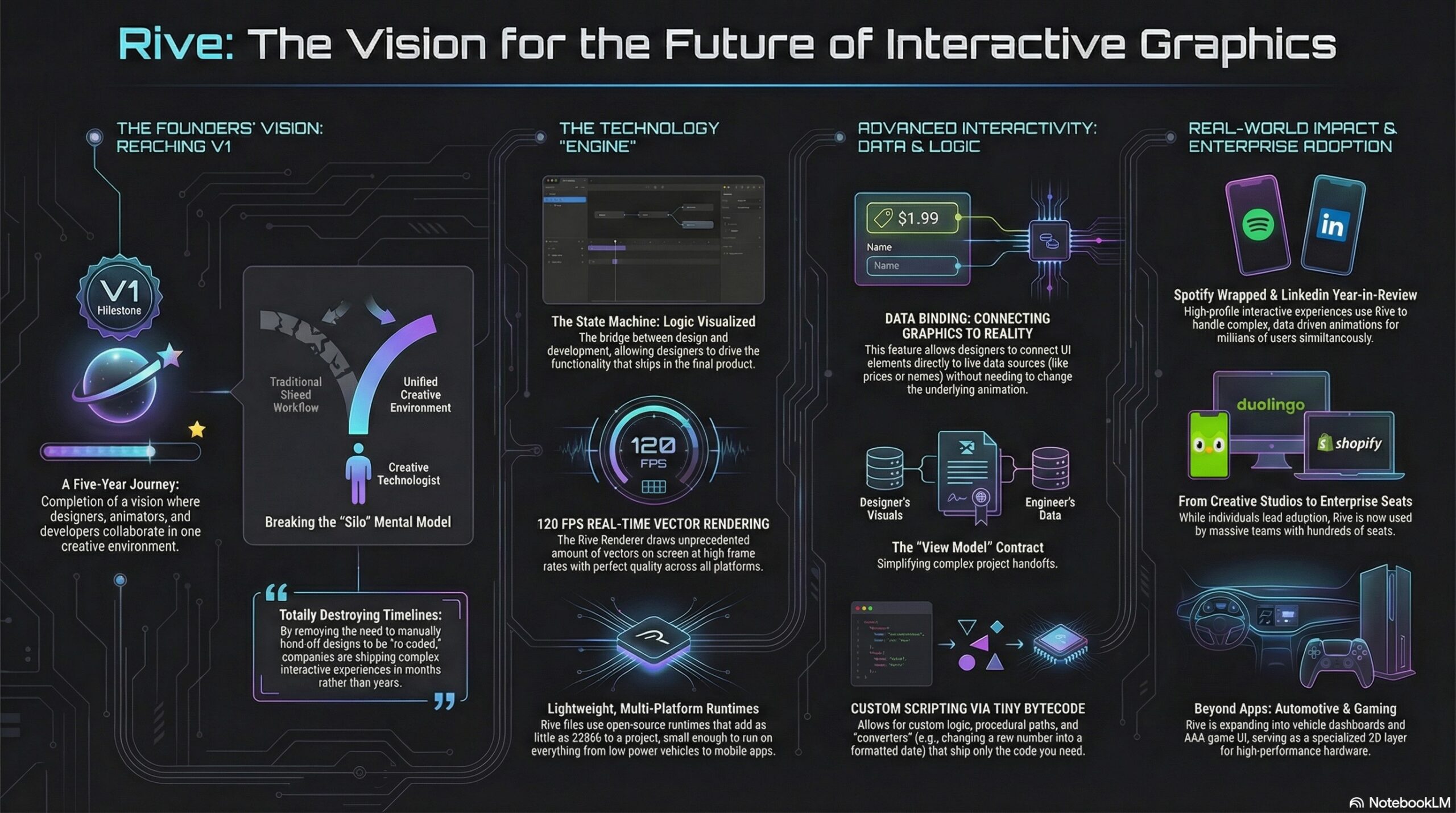
Table of contents:
Reflecting on 2025: A Year of Milestones 00:24
The Challenges of a Three-Sided Marketplace 02:58
Adoption Across Designers, Developers, and Companies 04:11
The Evolution of Design and Development Collaboration 05:46
The Power of Data Binding and Scripting 07:01
Rive’s Impact on Product Teams and Large Enterprises 09:18
The Future of Interactive Experiences with Rive 12:36
Understanding Rive’s Mental Model and Scripting 24:32
Comparing Rive’s Scripting to After Effects and Flash
The Vision for Rive in Game Development 31:30
Real-Time Data Integration and Future Possibilities 40:26
Spotify Wrapped: A Showcase of Rive’s Potential 42:08
Breaking Down Complex Experiences 46:18
Creative Technologists and Their Impact 51:07
The Future of Rive: 3D and Beyond 59:30
Opportunities for Motion Designers with Rive 1:11:38
That’s it. That’s the post. Happy Monday. 🙂
There’s almost no limit to my insane love of practical animal puppetry (usually the sillier, the better—e.g. Triumph, The Falconer), so I naturally loved this peek behind the scenes of Apple’s new spot:
Puppeteers dressed like blueberries. Individually placed whiskers. An entire forest built 3 feet off the ground. And so much more.
Bonus: Check out this look into the making of a similarly great Portland tourism commercial:
How well can Gemini make visual sense of various famous plots? Well… kind of well? 🙂 You be the judge.
“The Dude Conceives” — Testing @GeminiApp + @NanoBanana to visually explain The Big Lebowski, Die Hard, Citizen Kane, and The Godfather.
I find the glitches weirdly charming (e.g. Bunny Lebowski as actual bunny!). pic.twitter.com/dT3X3423Ee
— John Nack (@jnack) November 24, 2025
Passion is contagious, and I love when people deeply care what they’re bringing into the world. I had no idea I could find the details of fast-food chicken so interesting, but dang if founder Todd Graves’s enthusiasm doesn’t jump right off the screen. Seriously, give it a watch!
Nice clip for any product maker.
(also highlights how every business is complex when you get into the details – it is useful to remember this because many in tech give the excuse “oh, my product is complex and special” – EVERYTHING is complex and it’s your job to deal with that) https://t.co/zgd4uAsGsl
— Shreyas Doshi (@shreyas) November 16, 2025
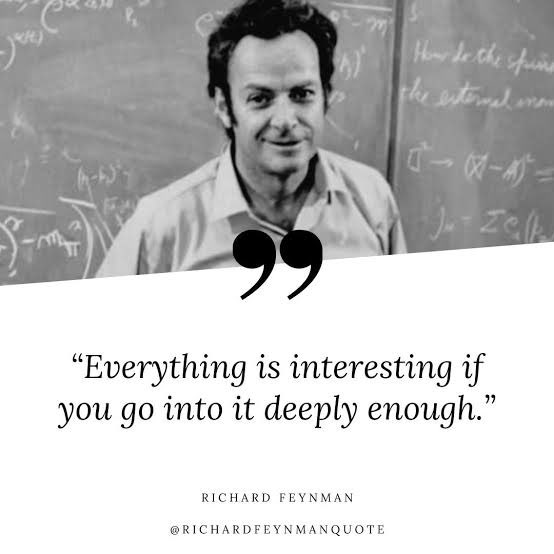
I’m reminded of Richard Feynman’s keen observation:
More tangentially, this gets me thinking back to my actor friends’ appreciation of Don Cheadle’s craft in this scene from Boogie Nights. “I could watch that guy pick out donuts all day!” And even though I can’t grok the work nearly as deeply as they do, I love how much they love it.
“Jesus Christ!!” — my 16yo Lego lover
View this post on Instagram
“A few weeks ago,” writes John Gruber, “designer James Barnard made this TikTok video about what seemed to be a few mistakes in HBO’s logo. He got a bunch of crap from commenters arguing that they weren’t mistakes at all. Then he heard from the designer of the original version of the logo, from the 1970s.”
Check out these surprisingly interesting three minutes of logo design history:
@barnardco “Who. Cares? Unfollowed” This is how a *lot* of people responded to my post about the mistake in the HBO logo. For those that didn’t see it, the H and the B of the logo don’t line up at the top of the official vector version from the website. Not only that, but the original designer @Gerard Huerta700 got in touch! Long story short, we’re all good, and Designerrrs™ community members can watch my interview with Gerard Huerta where we talk about this and his illustrious career! #hbo #typography #logodesign #logo #designtok original sound – James Barnard
Oddly enough, my son was just asking me about how the tiny batteries in these things work. Check out this surprisingly accessible & detailed peek inside.
Here, take a moment, let it wash over you. 🙂 (And if you’re still hungry, you can see more from creator Andrzej Łukomski here.)
“If you’re into weird cars, forgotten history, and stories that don’t end well, hit that subscribe button.”
I found this piece really interesting, not least because my wife & I are headed to Africa for the first time next week, and I’m eager to learn what kinds of vehicles & roads we’ll experience. Seems like something like the Africar would make a ton of sense in many places:
Super fun, lovely stuff from David Szauder.
I’ll note the fact of AI having been involved only because at this point who cares whether AI was involved? We’re happily reaching a plane of maturity where the particular mix of tooling is much less interesting than the vision & vibe.
John Gruber recently linked back to this clip in which designer Neven Mrgan highlights what feels like an important consideration in the age of mass-generated AI “designs”:
I think that was what mattered is that they looked rich, they looked like a lot of work had been put into them. That’s what people latch onto. It seems it’s something that, yes, they should have spent money on, and they should be spending time on right now.
Regardless of what tools were used in the making of a piece, does it feel rich, crafted, thoughtfully made? Does it have a point, and a point of view? As production gets faster, those qualities will become all the more critical for anything—and anyone—wishing to stand out.
I’m feeling (un)seen. 🙂
Splice (2D/3D design in your browser) has added support for progressive blur & gradients, and the results look awesome.
I haven’t seen anything advance like this in Adobe‘s core apps in maybe 20 years— maybe 25, since Illustrator & Acrobat added support for transparency.
We are adding Progressive Blur + Gradients to Hana!
All interactive, all real-time.Demo in the comments. pic.twitter.com/AnpmkxzNms
— Spline (@splinetool) May 27, 2025
On an aesthetically similar note, check out the launch video for the new version of Sketch (still very much alive & kicking in an age of Figma, it seems):
Remember when we said auto layout was coming to Sketch? It’s here. It’s called Stacks, and it’s part of our biggest release ever — out now.
There’s a lot to cover, so buckle up and we’ll give you a tour.
Also, stick around for a surprise at the end of the thread
Let’s go ↓ pic.twitter.com/QdiscCCRiD
— Sketch (@sketch) May 27, 2025
Wild devotion to capture, organization, and alignment:
The sheer insanity of this undertaking… At a glance it seems like a product of AI, but evidently it’s entirely real. I’m here for it!
As Motionographer aptly puts it,
Director John Likens and FX Supervisor Tomas Slancik dissect existential collapse in Your Friends & Neighbors’ haunting opener, blending Jon Hamm’s live-action gravitas with a symphony of digital decay. […]
Shot across two days and polished by world-class VFX artists, the title sequence mirrors Hamm’s crumbling protagonist, juxtaposing his stoic performance against hyper-detailed destruction.
Heh—this proposed Lego set would be 1000% up my alley. Click/swipe through the gallery to see fun animations:
I really hope that the makers of traditional vector-editing apps are paying attention to rich, modern, GPU-friendly techniques like this one. (If not—and I somewhat cynically expect that it’s not—it won’t be for my lack of trying to put it onto their radar. ¯\_(ツ)_/¯)
Introducing Vector Feathering — a new way to create vector glow and shadow effects. Vector Feathering is a technique we invented at Rive that can soften the edge of vector paths without the typical performance impact of traditional blur effects. (Audio on) pic.twitter.com/39kfjmFsTJ
— Rive (@rive_app) February 11, 2025
ChatGPT has famous marks marching to fuzz:
How about using the same prompt to create fluffy logos? https://t.co/SIVCbhmJ1x pic.twitter.com/m4wyF7zADM
— Gizem Akdag (@gizakdag) April 13, 2025
And now Microsoft Designer has me feeling truly warm & fuzzy:

Wow—I marvel at the insane, loving attention to detail in this shot-for-shot re-creation of a scene from Interstellar:
The creator writes,
I started working on this project in mid-2023, and it has been an incredible challenge, from modeling and animation to rendering and post-production. Every detail, from the explosive detachment of the Ranger to the rotation of the Endurance, the space suits of the minifigures, the insides of the Lander, and even the planet in the background, was carefully recreated in 3D.
Interstellar is one of the films that has moved me the most. Its story, visuals, and soundtrack left a lasting impact on me, and this video is my personal love letter to the movie—and to cinema in general. I wanted to capture the intensity and emotion of this scene in LEGO form, as a tribute to the power of storytelling through film.
Side by side:
Oh man, this vid from Aaron Draplin—stalwart hoarder of obsolete removable media—gave me all the feels, and if you’re a creative of a certain age, it might give you them, too:
Heh—let’s get funcomfortable with Katerina Kamprani:
Is it for me? Dunno: lately the only thing that justifies shooting with something other than my phone is a big, fast zoom lens, and I don’t know whether pairing such a thing with this slim beauty would kinda defeat the purpose. Still, I must know more…
Here’s a nice early look at the cam plus a couple of newly announced lenses:
Building on the strong work from the previous season,
Berlin’s Extraweg have created… a full-blown motion design masterpiece that takes you on a wild ride through Mark’s fractured psyche. Think trippy CGI, hypnotic 3D animations, and a surreal vibe that’ll leave you questioning reality. It’s like Inception met a kaleidoscope, and they decided to throw a rave in your brain. [more]
I really love the way the visual medium (simply black & white dots) enriches & evolves right alongside its subject matter in this ad for ChatGPT, and I hope we get to hear more soon from the creative team behind it.
What an amazingly simple, charming idea for a campaign. Swipe through the post to see the clever applications:
Up my alley, or way up my alley?? 🙂
View this post on Instagram
Great stuff, as always, from 99 Percent Invisible:
Having taken the kids (and dog!) to the Las Vegas Museum of Neon (photos), now I want to drop by its Warsaw counterpart:

I hope you’ve been able to spend at least some warm times with friends & family this holiday season, and here’s to a great new year of crackling creativity:
“From big-city go-getter to small-town goat-getter…” and the obligatory near-beards are in full effect:
If you or folks you know might be a good fit for one or more of these roles, please check ’em out & pass along info. Here’s some context from design director Mike Davidson.
————
These positions are United States only, Redmond-preferred, but we’ll also consider the Bay Area and other locations:
These positions are specifically in our lovely Mountain View office:

Happy Halloween, y’all!
You know I love some stop-motion animation, and the vibe & copywriting here are more cheeky & charming than just about anything I’ve seen in a while:
Heh—charming vaporwave & chiptune:
Peeps of a certain age & demographic see these & get immediate PBS/WGBH vibes:
“Tell me about a product you hate that you use regularly.” I asked this question of hundreds of Google PM candidates I interviewed, and it was always a great bozo detector. Most people don’t have much of an answer—no real passion or perspective. I want to know not just what sucks, but why it sucks.
If I were asked the same question, I’d immediately say “Every car infotainment system ever made.” As Tolstoy might say, “Each one is unhappy in its own way.” The most interesting thing, I think, isn’t just to talk about the crappy mismatched & competing experiences, but rather about why every system I’ve ever used sucks. The answer can’t be “Every person at every company is a moron”—so what is it?
So much comes down to the structure of the industry, with hardware & software being made by a mishmash of corporate frenemies, all contending with a soup of regulations, risk aversion (one recall can destroy the profitability of a whole product line), and surprisingly bargain-bin electronics.
Despite all that, talented folks continue to fight the good fight, and I enjoyed John LePore’s speculative designs that reinterpret the instrument clusters of classic cars (from Corvettes to DeLoreans) through Apple’s latest CarPlay framework:
No, YOU’RE obsessed with instrument clusters pic.twitter.com/deE0YgAhGY
— John LePore (@JohnnyMotion) June 26, 2024
Uizard (“Wizard”), which was recently acquired by Miro, has rolled out Autodesigner 2.0:
We take the intuitive conversational flow of ChatGPT and merge it with Uizard generative UI capabilities and drag-and-drop editor, to provide you with an intuitive UI design generator. You can turn a couple of ideas into a digital product design concept in a flash!
I’m really curious to see how the application of LLMs & conversational AI reshapes the design process, from ideation & collaboration to execution, deployment, and learning—and I’d love to hear your thoughts! Meanwhile here’s a very concise look at how Autodesigner works:
And if that piques your interest, here’s a more in-depth look:
99% Invisible is back at it, uncovering hidden but fascinating bits of design in action. This time around it’s concerned with the art of movie title & poster design—specifically with how to deal with actors who insist on being top billed. In the case of the otherwise forgotten movie Outrageous Fortune:
Two different prints of the movie were made, one listing Shelley Long’s name first and the other listing Bette Midler’s name first. Not only that, two different covers to take-home products (LaserDisc and VHS) were also made, with different names first. The art was mirrored, so that the names aligned with the actors images.
One interesting pattern that’s emerged is to place one actor’s name in the lower left & another in the upper right—thus deliberately conflicting with normal reading order in English:

Anyway, as always with this show, just trust me—the subject is way more interesting than you might think.
Man do I ever love these guys. Do yourself a solid and listen to this quick, accessible history covering the design of the ’68 games in Mexico City—one inexorably wrapped up in political conflict & civic design. It’s great.

Oh man, I wish I could say that my high school art career didn’t involve a whole bunch of these things, but OMG it sure did. :-p
Many, many years ago, I delighted in experimenting with vector copies of famous logos I could download from the, um, copyright-agnostic Logotypes.ru. That site seems to be gone now, but this quick vid highlights some others you might find useful:
I’ll bet that the myriad effects shown here—from Magritte-like negative space to buildings vibing to the beat—were far trickier to pull off than one might guess from their matter-of-fact presentation, and I love how simply & organically they come together:
Last year I posted about the Imaginary Forces’ beautiful, eerie title sequence for Amazon’s Jack Ryan series, and now School of Motion has sat down for an in-depth discussion with creative director Karin Fong. They talk about a wide range of topics, including AI & its possible impacts towards the 1:09 mark.
Here’s a look behind the scenes of the Jack Ryan sequence:
My friend Kevin McMahon got tapped to help the research team put their shimmering smart fabric onto the red carpet:
View this post on Instagram
Here’s a glimpse behind the scenes:
View this post on Instagram
Who’s up for a high-speed challenge in both engineering & filmmaking? Check out some truly impressive examples of both:
[Via Nate Boermann]
Stunning work from Legosteeze. Make sure to click the arrows on the post to see all the clips (amazingly based on real-world footage!):
View this post on Instagram
View this post on Instagram
[Via Cristobal Garcia]
Wes Anderson & crew are back to making delightful miniature worlds, this time for “The Wonderful Story of Henry Sugar.” Enjoy three charming minutes, won’t you?
It’s just a super quick tease, but this vid shows Windows 11 calling Express in order to make an Instagram reel from the user’s photos. Check it out:

