I’ll be honest, I was kinda bewildered when I first encountered this new mode in Photoshop the other day. As usual, though, spending a couple of minutes with Julieanne Kost adds a lot of clarity:
Bonus phrase: “100% mountain goat.”

[YouTube]
I’ll be honest, I was kinda bewildered when I first encountered this new mode in Photoshop the other day. As usual, though, spending a couple of minutes with Julieanne Kost adds a lot of clarity:
Bonus phrase: “100% mountain goat.”
[YouTube]
Lovely. PetaPixel writes,
Google Maps and Google Earth just got a whole lot sharper thanks to NASA and its Landsat 8 satellite. Using beautiful high-res imagery captured by the new satellite, Google has built a better high-res cloud-free mosaic of the world based on some 700 trillion pixels of data.
Check out the difference below:

See the team blog post for examples & interesting details:
Like our previous mosaic, we mined data from nearly a petabyte of Landsat imagery—that’s more than 700 trillion individual pixels—to choose the best cloud-free pixels. To put that in perspective, 700 trillion pixels is 7,000 times more pixels than the estimated number of stars in the Milky Way Galaxy, or 70 times more pixels than the estimated number of galaxies in the Universe.
This thing is beyond bananas:
The Mill has created The Mill BLACKBIRD, the first fully adjustable car rig that creates photoreal CG cars – it’s a car rig that can be shot at any time, in any location, without the need to rely on a physical car. Created in collaboration with JemFX, Performance Filmworks and Keslow, Mill Blackbird inspires and expands creative opportunities, offering a truly flexible production tool without sacrificing any quality or direction.

[YouTube] [Via Scott Valentine]
“Visiting The Gates was one of the highlights of my life,” says Margot wistfully, wishing we could make it to Italy to walk on the Floating Piers. At least this short film gets us closer:
Visitors can experience this work of art by walking on it from Sulzano to Monte Isola and to the island of San Paolo, which is framed by The Floating Piers. The mountains surrounding the lake offer a bird’s-eye view of The Floating Piers, exposing unnoticed angles and altering perspectives. Lake Iseo is located 100 kilometers east of Milan and 200 kilometers west of Venice.
“Like all of our projects, The Floating Piers is absolutely free and accessible 24 hours a day, weather permitting,” said Christo. “There are no tickets, no openings, no reservations and no owners. The Floating Piers are an extension of the street and belong to everyone.”

Rolling out today on iOS & Android, the release delivers some bigger stuff…
- A Blue filter in Black and white – this creates a high contrast black and white image by pushing blue tones white and yellow tones black (check out the image for a comparison of all color filters)
- White Balance in the RAW editor on Android – use the color picker to select a neutral color in the photo for automatic corrections, or choose from 8 different presets like Tungsten, Daylight and Sunny
- Added Talkback capability for Healing tool on Android – with Talkback enabled, the Healing tool will announce where the patch is being applied
- Fixed a crash on iOS when flipping images under specific conditions
- Minor bug fixes

Yay! CNET reports,
As Google did with Android, Apple will package the raw data in Adobe’s Digital Negative (DNG) format, a move that makes it easier for software such as Photoshop to view the files.
Third-party camera apps will also be able to take Live Photos — Apple’s technology for taking a short video clip, currently available only in Apple’s camera app. And on supported hardware, cameras will be able to record a wider range of colors, too, for more vivid photos.
I was happy to see that iOS will evidently auto-stabilize Live Photos. If you want that capability today, grab Google Motion Stills, and if you want to do raw editing on mobile, grab Snapseed for Android.

[Via Bryan O’Neil Hughes, who came up with the term “DN(e)G” as we were BS’ing on a road trip to San Luis Obispo long ago]
Why do I keep waiting for the apocalyptic flash here?
“Las Vegas In Infrared” is a new 4-minute short film by Philip Bloom, who visited Las Vegas with a Sony RX100 IV that had been modified for infrared photography through having its filter removed. Most of what you see was shot from a moving vehicle with 2 second bursts at 250fps through a 665nm filter.
Get much more useful Live Photos (those 3-second clips that the iPhone 6s shoots alongside still images) thanks to Motion Stills, a new app from Google Research. The team writes:
We use our video stabilization technology to freeze the background into a still photo or create sweeping cinematic pans. The resulting looping GIFs and movies come alive, and can easily be shared via messaging or on social media.
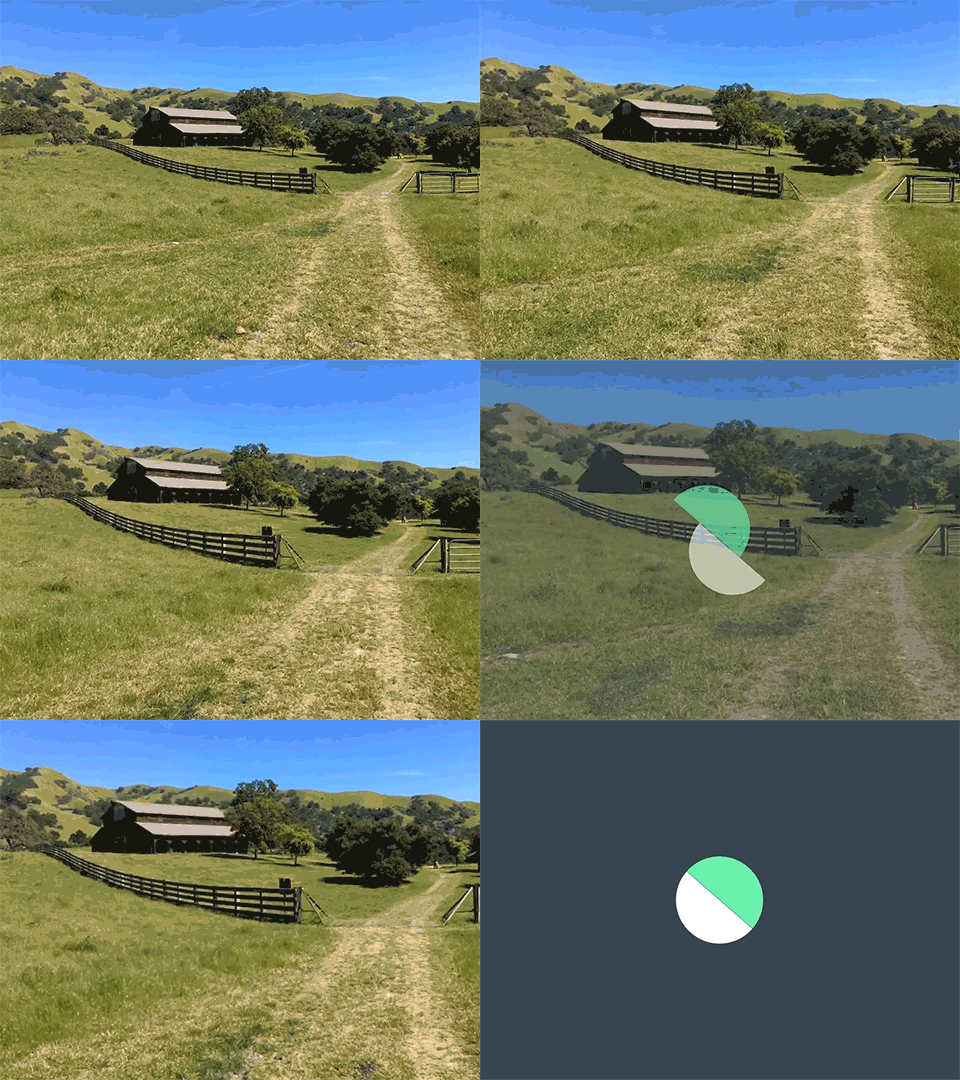
I’ve been using the app for months & find it absolutely indispensable, both for making multi-shot compositions like this…
…and for making stills where only the subject is moving:
I hope you enjoy it as much as we have!
As you rotate an image, PS can automatically synthesize content to fill in the resulting gaps. Looks cool! (If you want to use something similar right now, fire up Snapseed & apply the Transform filter. It’ll fill in gaps when you adjust horizontal & vertical perspective as well as rotation.)
[YouTube] [Via John Peterson]
It’s now much faster to apply the same edits to a number of images in sequence:
Apply Last Edits from the Main Screen. Use this feature to apply the same edits on a new photo that have been applied to the last saved photo. This feature only applies adjustments that have no local dependencies (i.e. no crop, transform or brush filters)
You can also use a new toggle switch inside the Straighten filter to flip an image horizontally:
Horizontal flip. Use this feature to horizontally mirror a photo, for example to fix front camera selfies which did not get mirrored correctly by the camera app.

And last but not least:
On Android Snapseed now displays more photo metadata information, including a map if the photo contains GPS information.
Mesmerizing.
Around 13 times per century, Mercury passes between Earth and the sun in a rare astronomical event known as a planetary transit. The 2016 Mercury transit occurred on May 9, between roughly 7:12 a.m. and 2:42 p.m. EDT.
Makes me want to go re-watch Danny Boyle’s fantastic Sunshine.

[YouTube]
Lovely aliens among us—if you count 2.3 miles under the surface of the sea as being “among us”:
Deep-diving NOAA writes,
This stunningly beautiful jellyfish was seen during Dive 4 of the 2016 Deepwater Exploration of the Marianas expedition on April 24, 2016, while exploring Enigma Seamount at a depth of ~3,700 meters.
Scientists identified this hydromedusa as belonging to the genus Crossota. Note the two sets of tentacles — short and long. At the beginning of the video, you’ll see that the long tentacles are even and extended outward and the bell is motionless. This suggests an ambush predation mode. Within the bell, the radial canals in red are connecting points for what looks like the gonads in bright yellow.

Oh vanity of vanities, you sure look neat. This little foldable devil promises to follow you around while filming:

The Brooklyn Aerials crew took Hitchcock’s dizzying “Vertigo effect” aloft in this new short film:
PetaPixel explains,
The rolling, tilting, and panning motions helped set their video apart, but it’s the vertigo effect where Balance really stands out. For each of those shots they used a Canon CN-E 15.5-47mm zoom lens, starting at 47mm and zooming out to its widest angle while simultaneously moving the drone towards the subject, keeping the subject the same size.
Here’s a peek behind the scenes:
My new friend “Big Alex”* Osterloh from Google Munich brought his drone & GoPro to Nepal to help document the local folks we sought to help. In the short video below he mixes that footage with some photos that I & others took:
And here’s a longer version featuring more photos & vids from Alex:
*The trip also featured “Regular Alex” (from Bulgaria) and “Girl Alix” (a volunteer coordinator from All Hands). We didn’t want to call Regular Alex “Little Alex,” so some members of the trip were deeply confused upon hearing references to “Girl Alix” (not knowing that we’d taken on a third person by that name).
RED Epic Dragon + a room with a view? Yes please.
Engadget writes,
This isn’t the first ultra-high definition video sent from the ISS: NASA sent the RED camera up back in January 2015 and started uploading 4K video to YouTube last June. Most of the videos in NASA’s UHD archive are of experiments done inside the space station. It’s cool to watch bubbles wiggle in zero-G, but it pales compared to a carefully-framed shot of the globe spinning underneath the camera.
Bonus: Auroras!
Watching this in fullscreen, I kept waiting to feel the spray on my cheeks. The Hans Zimmer score that eventually appears is lovely, but I’m struck by how powerfully the opening shots can stand on their own.
Filmmaker Chris Bryan notes, “All images where shot using The Phantom Flex, Phantom Miro M-320S and the new Phantom 4K Flex with Arri Ultra prime lenses and Chris Bryan Films custom underwater housing.”
[Vimeo]
Nice!
Join Scott Kelby as he shows you all of his tips and secrets for using the FREE Nik Collection from Google! This plug-in suite has long been many photographers’ secret weapon, and now it’s free to everyone! In this brand new class, Scott will walk you through each of the eight plug-ins in the suite and show you how to best utilize them to your advantage. From making killer black and white images with Silver Efex Pro, to adding a special look to your images with Color Efex Pro, using Viveza to control specific colors, creating amazing HDR images with HDR Efex Pro, refining the details with Dfine and Sharpener Pro, or making your digital images look like film with Analog Efex Pro, Scott has you covered!
Thanks, Scott!
[Related/previous: Tim Grey releases free Nik training.]

Take a look at me now…
Phil Collins Reshot All His Original Album Covers for the 2016 Reissues
Famed musician Phil Collins began reissuing some of his most loved albums in November of 2015 as part of a collection called “Take a look at me now…”

…and after a drink or three:
Tipsy Portrait Project Captures People After 1, 2, and 3 Glasses of Wine
Brazilian photographer Marcos Alberti‘s ‘Wine Project’ portrait series is dead simple: give your subjects some booze and photograph them between drinks. But the resulting portraits are taking the Web by storm.

With just your computer, or even better through a Cardboard headset, you can step inside Abbey Road, stepping right into 360º orchestral performances and more.

As the team writes,
[Enjoy] a nine-part guided tour narrated by Giles Martin, the son of the late Beatles producer, George Martin, who shares the history of the studios from the 1930’s to present day.
After the tour, you can quite literally move around the studios at your leisure to see hidden treasures like Studio 3’s Mirrored Drum Room, where the mirrors help to create a close, bright and loud sound quality. Uncover one of Abbey Road’s Mastering Suites, where a record gets its finishing touches before a release. In Studio 1, experience what it’s like to be in a recording session with the London Symphony Orchestra with surround sound.

Tim Grey, the author of over a dozen books and dozens of video training courses for photographers, has announced that he will now give away all his video courses related to the Nik Collection for free as well!
The course bundle he’s giving away includes 4 courses: Basics of Using the Nik Collection, Learning Viveza 2, Learning Analog Efex Pro, and Learning Silver Efex Pro. So if you downloaded the newly-free Nik Collection last week but haven’t cracked it open yet, this is a great free way to get familiar with Nik and learn your way around the plugin suite.
Thanks, Tim!

“Purgatory, USA.” So, so good—as is season 1 (which I finally got to see thanks to interminable international flights).
Don’t miss the Art of the Title’s illuminating deep dive behind the scenes with creative director Patrick Clair.


[Vimeo]
Power to the people!
Starting March 24, 2016, the latest Nik Collection will be freely available to download: Analog Efex Pro, Color Efex Pro, Silver Efex Pro, Viveza, HDR Efex Pro, Sharpener Pro and Dfine. If you purchased the Nik Collection in 2016, you will receive a full refund, which we’ll automatically issue back to you in the coming days.
We’re excited to bring the powerful photo editing tools once only used by professionals to even more people now.
[Via]
Hi from Nepal, everyone!
I’m enjoying some very rare downtime & connectivity before getting some shut-eye in advance of our 48-hour hackathon. I have so much to share, but uploading through a cocktail straw is nobody’s idea of fun, so most will have to wait. In very brief: Yesterday we celebrated Holi at an orphanage; today we helped villagers rebuild (such a minor contribution, really, but it felt good to help such welcoming folks); and tomorrow we get busy trying to create technologies & services that might be of use here & beyond. It’s such a privilege to come here and learn. I’ll share more as soon as time & tech permit.

[Photo courtesy of Alex Osterloh, with whom I treated myself to a dawn fly-by of Everest, below]
In the land where beautification app Meitu “has acquired a user base of over 900 million,”
[T]he obsession has spilled over into the virtual world with a selfie camera that automatically perfects your face in every photo you take. The camera, made by Casio, is nicknamed zipai shenqi (which means the magical weapon for ultimate selfies) in China. It gets rid of blemishes and makes your face slimmer, skin whiter, and eyes bigger. You can see it in action in the video above.

Intriguing work by Anthony Cerniello:
Kottke writes,
Last Thanksgiving, Cerniello traveled to his friend Danielle’s family reunion and with still photographer Keith Sirchio shot portraits of her youngest cousins through to her oldest relatives with a Hasselblad medium format camera. Then began the process of scanning each photo with a drum scanner at the U.N. in New York, at which point he carefully edited the photos to select the family members that had the most similar bone structure. Next he brought on animators Nathan Meier and Edmund Earle who worked in After Effects and 3D Studio Max to morph and animate the still photos to make them lifelike as possible. Finally, Nuke (a kind of 3D visual effects software) artist George Cuddy was brought on to smooth out some small details like the eyes and hair.
[Vimeo]
PetaPixel notes, “The video was captured with a Vision Research Phantom Flex 4K camera with a Fujinon 18-85mm lens mounted to it, shooting wide open at T2” at 1977 frames per second:
There’s a little black spot from the Sun today…
PetaPixel writes,
[NASA satellite] DSCOVR snapped its first photo in July 2015, so this view of a total solar eclipse is the first of its kind. Since the DSCOVR has a fixed view of Earth as it rotates on its axis, this is the first time the shadow of an entire eclipse has been documented in a series of photos.
In August 2015, DSCOVR also captured an amazing series of images showing the moon passing across the face of the Earth.
Love this animation. I don’t know who created it, but HT to Katrin Eismann for sharing it.
I’m guessing the average GoPro buyer’s life cycle goes like this:
And thus to address their “Achille’s heel,” GoPro just spent $100M+ buying Stupeflix, makers of the excellent Replay movie-making app (Apple’s 2014 App of the Year) as well as video editor Splice. Congrats to the makers of these excellent tools. I’m really eager to see what they can do together & with GoPro.
Meanwhile GoPro competitor the TomTom Bandit uses sensor data (speed, G-force, even max heart rate) to annotate what it captures (see below). As someone who knows just how hard it is for software to discern the really important moments in a video (Cf. the movies feature in Google Photos), I’m excited to see richer data sets captured & surfaced to users. Check out The Verge’s review for details.

Photographer Eric Paré created this 360-degree light painting photo booth for Adobe’s MAX show last fall:
PetaPixel writes,
The rig was built using 32 DSLR cameras, which were connected to be triggered in perfect sync with one another. Surrounding the photo booth was a dark black tent that helped keep light out. Nearly 1,000 attendees entered the booth over the 3 days of the conference, creating 4,000 sets of images.
[Vimeo]
Beautiful, terrible images from firechaser Jeff Frost & team:
FIRE CHASERS – 4K download [exp 03/15] from Jeff Frost on Vimeo.
US wildfires burned 10 million acres in the US last year exceeding six billion dollars in costs, making it the most destructive annual natural disaster in the world. Fire Chasers plunges deeper into California wildfires than ever before with unprecedented access granted by CalFire and the breathtaking imagery of acclaimed film and photo artist, Jeff Frost. This visually groundbreaking project follows the intersecting lives of firefighters and those who record their fury; an epic adventure film with a vital message.
Coffee table photography book to be released through minormattersbooks.com.
Better stabilization & zooming would be hugely useful to almost any mobile photographer, though I’m more intrigued by possibilities of better depth sensing & segmentation:
PetaPixel writes,
Instead of the mechanical optical zoom found in traditional zoom systems, Corephotonics’ technology zooms using just the two cameras and no moving parts. One of the cameras has a telephoto lens and the other has a wide angle one. By combining the images from the two cameras together, Corephotonics is able to achieve both optical zoom and better image quality.
[YouTube]
This little beast looks pretty interesting, though pricing is TBD:
I find the 360º video captures (example) moderately interesting, but I experience FOMO (fear of missing out, i.e. worrying that I’m looking in the wrong direction) and slight motion sickness. I’m much more interested capturing sequential spherical photos a la Street View, letting me navigate my travels via hyperlapse & pause to re-explore any spot.
I wonder—could someone craft a wearable rig (hat?) for this kind of camera that would let me set it & forget it during hikes, etc.? Or would that kind of contraption be so dorktastic as to make Google Glass & selfie sticks look like portraits in elegance?
Maybe with all the 360º cams now coming onto the market, we’ll find out soon enough.
[YouTube]
Photographers Ken Browar and Deborah Ory have teamed up with Misty Copeland to recreate some of the painter’s most famous works:

The print edition is well worth a look if you get a chance.
PetaPixel notes,
“It was interesting to be on a shoot and to not have the freedom to just create like I normally do with my body,” Copeland tells Harper’s Bazaar. “Trying to re-create what Degas did was really difficult. It was amazing just to notice all of the small details but also how he still allows you to feel like there’s movement.”
[YouTube]
“What Bill Gates was to the personal computer, Artur Fischer is to do-it-yourself home repair,” writes Der Spiegel. From the drywall anchor to the synchronized flash to Fischertechnik kits for kids, Mr. Fisher’s 1,100 patents (averaging 16 per year for decades!) enriched countless lives. Here’s a quick overview of his amazing career:
[YouTube]
I couldn’t say it better than Gizmodo does:
But honestly, the fancier Google Photos is far superior anyway with its unlimited photo and video storage and image recognition tech that makes searching your photo library a cinch. If you’re someone who’s pumped Picasa full of pics and videos, you can access that content in Google Photos.
Picasa isn’t going to stop working, but it isn’t going to get any more updates. Check out the team blog if you’d like more details.
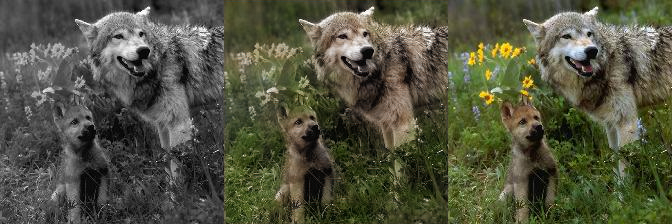
Let’s say the TRON laser had digitized Ted Turner (film colorization nut in the 80’s) instead of Jeff Bridges. His roving AI might now show up as Ryan Dahl’s automatic colorization process:
The input to the model is the left-side grayscale image. The output is the middle image. The right image is the true color—which the model never gets to see. (These are images are from the validation set.)
Interesting results below.
For a simpler (and freakier) colorization demo, stare at this image for 15 seconds.


[Via Pete Warden]
A couple bounced (literally) across 12 countries, creating this rather amazing compilation in the process:
PetaPixel writes,
There wasn’t a third person to help shoot photos, so everything was done with a tripod and a string (to keep the distances the same throughout the shots). Here’s a behind-the-scenes glimpse at how the duo managed to create all the photos themselves:
[YouTube]
Days of future past:

This—just… all of this:
Popular Photography writes,
The footage may look like something that was shot with a drone, but it was actually done with the GSS C520 camera stabilization system, which is typically used for helicopters. The whole thing was mounted to a pickup truck and the trail crew built a special road on which the truck could drive to get the shots.
Check out more info on the filmmakers’ blog. [YouTube]
“No iPhones were harmed during the making of this video,” says pro skier Nicolas Vuignier—but man, they sure could be. Epic results, though.
PetaPixel writes,
He swings his iPhone 6 camera around using a long rope… Vuignier says he spent the past 2 years tinkering and tweaking his creation, which appears to be a special mount that keeps the camera pointed directly at the swinger. It’s “100% shot with the iPhone 6,” he says.
[YouTube]


