Category Archives: Photography

Would photography please "die" already??

Ah, the indestructable "Is Photography Dead" meme…

Oh, who gives a crap?  Sorry, let me explain.  I thought about noting this not-so-little trend some time ago, but I’ve never been able to invest much passion in it.  People have been manipulating photography in every which way–through their choice of what to capture & what to omit; through changes to the scene/subject (adding lights, building sets, moving bodies on a battlefield); and through tweaks to the captured results–since the dawn of the technology.  So what?  I think Bridge engineering manager Arno Gourdol hit the nail on the head:

Being aware of composition, balance, symmetry and "owning the frame" is the creative act. The creative act matters, and the moment at which it occurs seems secondary–whether it is when pressing the shutter release on your camera, when making a print in the darkroom or when sitting in front of a computer.  This echoes the early days when photography was viewed as an unfair and unworthy competitor to painting…

I dunno; much of this "is photography dead" discussion strikes me as sterile and pointless–and maybe a strawman that’s not worth beating up.  Yet I wonder whether it’s driven by veteran photogs feeling threatened–comercially and aesthetically–by so many affordable tools that make competent image-making so much more attainable. 

Sure, yeah, we can debate this camera or lens vs. that one all day long–but all this stuff absolutely rocks compared to what pros were using just a few years back (to say nothing of what Arbus, Capa, Cartier-Bresson, and co. had).  You can say that digital makes us lazy, and there’s some truth there; and yet it also fosters free experimentation & instant review of the results.  That quicker learning cycle, plus autofocus, good software, etc. helps get people "good enough" (technically, anyway) without years of slow and costly apprenticeship.  And when anyone can take a technically decent shot, then "good" becomes "trite," and people seek to define themselves by bucking the trend–making portfolios blurry or murky.

Therefore–and maybe I’ll live to regret writing this–we end up with a bunch of freaked-out oldsters (or just curmudgeons at heart) twisting up a Dick Cheney grimace and saying, "Bah, I don’t like this digital tomfoolery–not one bit!  In my day we had to huff developer until we saw Ernest Borgnine floating in the liquid–and we liked it fine!!  You kids are ruining everything."

Um, yeah.  Life, art, and expression move on.  If "photography" is something so brittle & exclusionary that it can’t bear evolution, then goodbye and good riddance.  (Don’t let the film door hit your ass on the way out…) It isn’t, of course, so maybe we can just bury the is-photography-dead schtick.  But I’m not holding my breath.

Stoners, puzzles, & photos that aren't there

  • “In college, take a year off and drive across the country, and camp along the way,” “Old Geezer” advises young photographers. “Do it with good friends that are smart; not dumbasses that just want to get high. Bring some books. Bring some audio books if you can’t read.”  Also: “Always order good catering. That’s all the client really cares about.” [Via]
  • “This is a picture I did not take…”  On Unphotographable, Michael David Murphy describes the ones that got away. [Via]
  • Befuddlr creates interactive puzzles from the contents of Flickr.  To get one of your images into the game, you can–according to the folks at Photojojo–“Upload your photo to the Photojojo Flickr group, go to Befuddlr and click “photojojo”, select your photo, and scramble it into an online puzzle game! The site will even time your unscrambling attempts, making for a perfect mid-day office-wide showdown.” [Via]
  • Speaking of Flickr, Jason Kottke test-drives the Eye-Fi wireless memory card, which enables direct upload from your camera to Flickr–no cables required.  (This strikes me as cool tech, but I’d much rather have the perhaps impossible GPS-on-a-card.)  Elsewhere, Photopreneur.com offers up 36 Reasons Flickr is a Photographer’s Ultimate Tool.
  • DIYPhotography shows a cool way to make heart-shaped bokeh (lens blur). [Via]  Hmm–maybe we should add hearts as a shape option for Photoshop’s bokeh-making Lens Blur filter (see related tutorial).  If doing stuff like this is up your alley, check out their other tutorials–e.g. “Cheapest ring light ever” [Via] and high-speed photography at home (champagne glasses, BB gun, and subsequent eye patches sold separately).
  • Speaking of high speed photos, check out this beautiful collection of liquid art & droplet photography. [Via Dave Story]
  • Ecocentric offers a foxy camera bag made from old belts. [Via]

Stoners, puzzles, & photos that aren't there

  • “In college, take a year off and drive across the country, and camp along the way,” “Old Geezer” advises young photographers. “Do it with good friends that are smart; not dumbasses that just want to get high. Bring some books. Bring some audio books if you can’t read.”  Also: “Always order good catering. That’s all the client really cares about.” [Via]
  • “This is a picture I did not take…”  On Unphotographable, Michael David Murphy describes the ones that got away. [Via]
  • Befuddlr creates interactive puzzles from the contents of Flickr.  To get one of your images into the game, you can–according to the folks at Photojojo–“Upload your photo to the Photojojo Flickr group, go to Befuddlr and click “photojojo”, select your photo, and scramble it into an online puzzle game! The site will even time your unscrambling attempts, making for a perfect mid-day office-wide showdown.” [Via]
  • Speaking of Flickr, Jason Kottke test-drives the Eye-Fi wireless memory card, which enables direct upload from your camera to Flickr–no cables required.  (This strikes me as cool tech, but I’d much rather have the perhaps impossible GPS-on-a-card.)  Elsewhere, Photopreneur.com offers up 36 Reasons Flickr is a Photographer’s Ultimate Tool.
  • DIYPhotography shows a cool way to make heart-shaped bokeh (lens blur). [Via]  Hmm–maybe we should add hearts as a shape option for Photoshop’s bokeh-making Lens Blur filter (see related tutorial).  If doing stuff like this is up your alley, check out their other tutorials–e.g. “Cheapest ring light ever” [Via] and high-speed photography at home (champagne glasses, BB gun, and subsequent eye patches sold separately).
  • Speaking of high speed photos, check out this beautiful collection of liquid art & droplet photography. [Via Dave Story]
  • Ecocentric offers a foxy camera bag made from old belts. [Via]

African skinheads, found photos, and other slices of life

  • MangoFalls is a rather fascinating collection of photos from film found in thrift store cameras (kind of a photo-specific version of Found Magazine).  [Via]
  • Clayton James Cubitt’s Lagos Calling is “an anthropological study of African skinhead fashion from the early seventies.” [Via]
  • The Morning News features Aaron Hobson’s Cinemascapes plus a short interview with the photographer. [Via Thorsten Wulff]
  • Magnum Magnum celebrates the 60th anniversary of the famed photo agency.  I love the first two shots in this gallery.  [Via Marc Pawliger]
  • People & their breakfasts surveys–well, just that. [Via]  I think this kind of navel-(orange) gazing may be part of Why They Hate Us.

Plastic Man drives the lane, + other moments in time

  • SI photographer John Zimmerman captured a crazy image of Dr. J shot using a slit camera to follow the movement of his hand.  Hard to believe it’s from 1972!
  • Liquid sculpture: Photographer Martin Waugh (see previous) talks about how he combined high-speed photography with a bit of Photoshop to create the new Smirnoff ad campaign.
  • William Hundley makes some eye-popping jumping sheet photographs.  See more of his work on Flickr. [Via]
  • Sports Shooter hosts a cool gallery of indoor rodeo shots from Darryl Dyck. [Via]
  • Telling a very different story occasioned by cowboy imagery, LA Times photog Luis Sinco talks about how his shot of the "Marlboro Marine" James Blake Miller in Iraq changed both of their lives. [Via]  The story is behind an irritating, albeit free, registration barrier.

Feedback, please: Photomerge in Photoshop

[Update: Though the interactive mode of Photomerge is no longer installed by default in Photoshop CS4, you can download & install the plug-in: see links for Mac & Win.]

The Photoshop team could use your guidance in setting priorities around our panorama-creation tools.

The automatic alignment & blending features introduced in CS3 have been really well received by photographers creating panoramas.  Panorama creation in CS2 and earlier relied on use of an interactive dialog (screenshot) that enabled the user to adjust the position and rotation of images before blending them together.  The improved algorithms in CS3, however, can usually produce good results without any user interaction, which is why Photomerge now defaults to “Auto” (screenshot) and bypasses the interactive dialog unless you request it.

So, here’s the question: Do we even need the interactive dialog anymore?  It’s built on an aging framework, so keeping it around would require some investment.  If you create panoramas using Photoshop CS3 and rely on the dialog, please let us know the details (via the comments) of how & why.

Thanks,
J.

PS–General feedback on panorama creation in Photoshop is always welcome, too, though the fate of the dialog is the most urgent issue.

[Update: As of CS4 the plug-in is no longer installed by default, but you can still download and use it if you’d like. –J.]

Spies, irony, and evil

Interesting recent photo finds:

  • Wee cams:
  • Try and stop us:
    • Strictly No Photography sticks it to the Man with an entire site composed of photos taken exactly where they’re forbidden. [Via]
    • "Photo-bans at pop art shows — irony impairment, or Dadaism?" asks Cory Doctorow.  "I wasn’t even allowed to photograph the ‘No Photographs’ sign. A member of staff explained that the typography and layout of the signs was itself copyrighted."
  • Darkness:
    • The NY Times has been covering some grim episodes in the history of humanity, as seen through photography:
      • The personal photos of Nazi death camp guards are a study in chilling banality.  See the accompanying slideshow.
      • Photographer Nhem En was made to photograph prisoners who had arrived to be tortured by the Khmer Rouge. “I had to clean, develop and dry the pictures on my own and take them to Duch by my own hand," he says.  "I couldn’t make a mistake. If one of the pictures was lost I would be killed."  On a related note, Khmer leader Pol Pot’s 1973 Mercedes limo is for sale on eBay.
      • The paper also features a multi-part essay from documentarian Errol Morris, charting his efforts to find the exact location of a famous photo from the Crimean war (the so-called Valley of the Shadow of Death).
    • Flickr hosts a small gallery of images from French nuclear tests. [Via]  In college one of these images adorned the basement wall of our hovel in South Bend, IN.

Jay Maisel NYC photo workshop announced

Renowned photographer Jay Maisel is offering a unique workshop in New York next month.  As a fair bit of this blog’s content concerns photography, I thought the details might be of interest.  From Jay:

This is an opportunity to take a workshop with Jay in his own environment, a historic landmark bank building in Lower Manhattan.

This is a workshop about seeing and expanding your capability.  It is not about performing or getting your ego stroked.  It is definitely not about technical things and absolutely not about Photoshop.  You will shoot, get critiques, look at Jay’s work and talk about photography all day long.

It will take place Mon. Dec. 17 to Fri. Dec. 21, from 9am to 10pm each day.  All meals are included.  The cost is $5000.  It will be filled on a first come, first served basis and will be limited to 9 participants.  Payment in full, in advance must be made in order to secure a spot.

The workshop is sponsored by SanDisk. Please call 212.431.5013 or email jay@jaymaisel.com for more information.

Fire on the mountain

Despite having flown through the deeply punishing winds, doing a touch-and-go landing at Burbank and seeing the flames from the air, somehow until now I failed to grasp the scale of the Southern California fires.  The excellent LA Times photo gallery*, however, brings home the reality.  I’m reminded of the word "terriblisma"–or as we might say it now, “shock and awe.” [Via]

*Opening in a new window to avoid irritating auto-resize of one’s browser.

Gigapixel panos through Flash

GigaPan.org is "sort of a Flickr for zoomable panoramas," notes Photoshop engineer (and Photomerge creator) John Peterson. The site makes it possible to upload & browse gigapixel-sized images, then navigate through them via a Flash interface.  Here’s a shot of Adobe HQ, taken from nearby Caesar Chavez park* in downtown San José.  (Bustling, isn’t it? ;-))  The site is labeled "beta," and the viewer currently leaves much to be desired (quit squirming around, dammit!), but it’s a very cool project nonetheless. [Via]

For more in this vein, see previous: Colossal images through Photoshop & Flash; 13 gigapixels or bust; 3.8 Gigapixels of Half Dome.

* I’m sure I walk by it all the time, but until seeing this image I never noticed the deeply gross sign in the park.  Click the second of the two snapshots below the Adobe pano to read it.  I’ll never think of the fountain in quite the same way.

Aperture vs. Lightroom: What do the pros use?

It’s been exactly two years since Apple threw its hat into the professional photography ring with the introduction of Aperture.  Adobe responded shortly thereafter with the introduction of Lightroom.  So, how does the pro photography market look now?
 
InfoTrends recently surveyed 1,026 professional photographers in North America to determine which software they used for raw file processing.  Here’s what folks reported: 

  • 66.5% using the Photoshop Camera Raw plug-in
  • 23.6% using Lightroom
  • 5.5% using Aperture

To be fair to Aperture, it might be helpful to remove Windows users from the equation for a moment.  Even after doing so, Lightroom’s usage among Mac-based pros is still nearly double that of Aperture (26.6% vs. 14.3%).

It’s also worth pointing out that photographers haven’t started to abandon Photoshop as a result of using tools such as Lightroom.  (Photoshop usage overall remains in the 90% range.)  The vast majority of photographers seem to understand pretty clearly the different nature & roles of the apps, and they continue to view Photoshop as a must-have part of any serious arsenal.

Lightroom is clearly off to a tremendous start, and everyone here is really pleased & grateful to the photography community for such a warm welcome.

Adobe puts 3D insect eyes on your camera

“Why,” I wondered for a long time, “is a wild-haired Eastern European guy walking around our floor carrying a medium-format camera & a hot glue gun?”  The answer, I discovered, is that Adobe research scientist Todor Georgiev* has been working on algorithms for use with a plenoptic camera & was motivated to build his own lenticular lens array.

So, what does any of that mean?  The goal is to let cameras capture a moment in time from multiple slightly different perspectives.  The resulting image (a series of smaller images, actually) might then enable the photographer to change the focal distance of the photo after the fact, or to use depth information to aid in selecting & editing objects.

News.com has more info & images, and I think the potential comes through best in Audioblog.fr’s video of Adobe VP Dave Story showing off the lens.  Gizmodo writes, “It’s a way-cool demo, but it might be a while before you see such a fancy lens on everyday cameras. But a focus brush in Photoshop? Whoa. Sign us up.” [Via Cari Gushiken]

*Okay, his hair seems to be less wild these days, but Todor still kicks out “light reading” like this (PDF). I think I left my copy at the beach.

TiltViewer: 3D Flash interface to Flickr

Felix Turner, creator of the all kinds of clean, lovely Flash photo displays (e.g. the Flickr Related Tag Browser, SimpleViewer, and PostcardViewer) returns with TiltViewer, an experimental interface that presents photos from Flickr’s "Interestingness" stream.  Clicking the icon on any image makes it possible to flip it over, see notes, and jump to the corresponding Flickr page (which I did for this groovy shot).  For details of the project, check out Felix’s blog.  For another great way to peruse Flickr, check out PicLens.

viewAt.org: Flash-based panorama sharing

The folks at viewAt.org have carved out an interesting mission for themselves: letting photographers around the world share their panoramas as interactive Flash creations. Citing the ubiquity of Flash over QuickTime, the site creators have devised a system whereby photogs can upload their panoramas, make them interactive (see instructions), and plot them on the Earth via Google Maps.  Site co-creator
Bernard Custard Gascó writes:

This project is totally free for anyone who wishes to upload their
panoramas and has the advantage of offering your uploads in Flash, thanks to a system developed by Denis Chumakov. Besides this, you can promote
your own website integrated on Google Earth.

Needless to say, you have complete control over your own work, and
obviously all rights are yours. By means of a simple code number, you can
insert the panoramas on your web page and authorize those which you allow
others to download.

Click around the map on the main page to view panos from all around the world.  Very cool work, guys.

Cool Recent Photography, Part 2

Cool Recent Photography, Part 1

Of jazz, Jawas, carnage, & more:

  • Kent Phelan shares a great shot of octagenarian jazz man Roy Haynes. [Via]
  • TrueGrain is "a pro-grade tool for accurately recapturing the aesthetics of black and white film with digital photography."  It’ll set you back $300.
  • The NYT features a slideshow from Turkey’s barren & striking Cappadocia; Jawas sold separately.  According to the gallery, the caves have been carved from soft rock.  I’d like to see caves carved into some really soft rock, like Nerf.  ("Or Air Supply," interjects Margot.)
  • Speaking of the NYT, they’ve been offering excellent prints for sale from their archives.  Dig Ruth Fremson’s photo of trams in the fog (info).  See also the ghostly Twin Towers in the fog; Lower Manhattan in the 60’s (hello, old office); Feeding the hippo at the Bronx Zoo.
  • The paper remembers the life and work of pioneering female photojournalist Gerda Taro (partner of Robert Capa), offering a slideshow of her work.
  • "Don’t look at me like a piece of meat!" But look at my hair that way.  If Julia Kissina’s carnage trips your trigger, see Pinar Yolacan’s work. [Via]

Free new presets for Camera Raw

I’m delighted to see that author Jack Davis & the folks at onOne Software have teamed up to release more than 100 presets designed to work in Adobe Camera Raw. Available previously for Lightroom, the set of presets has been expanded and refined for Camera Raw.  According to the site,

PhotoPresets with One-Click WOW! tackle only one development parameter at a time allowing you to optimize your image at each step to create the look you really want without sacrificing any one quality. You start with adjusting your images color and tone and then add effects like black and white conversions, tinting, split-toning and vignetting.

Scroll to the bottom of the page for video training, or just download the presets’ installer and start going to town. [Via]

13 gigapixels or bust; sketchy photogs; more

  • In Spectacle, photographers David Rockwell & Bruce Mau "celebrate the phenomenon and history of communal, awe-inspiring public performance worldwide–from the stadium to the streets, from religious festivals to political marches."  Dig the really well-chosen type treatments as well. [Via]
  • For a different kind of spectacle, see Harlem in 13 Gigapixels. Photographer Gerard Maynard & software developer Alexandre Jenny have teamed up to create a massive image of the famous New York neighborhood.  With results spanning 279,689 x 46,901 pixels, the project’s raw numbers
    are pretty eye-popping:

    • 2,045 individual photos from a Nikon D2X
    • 21.49 GB of compressed raw data
    • 1 day for image placement and color correction
    • 46 hours of rendering on an 8-core Xeon system with 8GB of RAM
    • Results: A single 48.8 GB image stored in the Photoshop Large Document format (.PSB), converted via Zoomify & displayed through the Flash Player.
      [Via Maria Brenny]  (If this is up your alley, see previous.)
  • Ah, the 1950’s, when you had to be the lookout for "corn-fed belles" hanging out of trees along the road, ready to disrobe in your U-Haul trailer.  At least that’s the world conjured up by the (more than a little creepy) Glamour Photography magazine–one "designed to give the camera man a better understanding of the technical and philosophical aspects of photographing pretty girls."  Philosophy–yes, that’s it. [Via]
  • Elsewhere in history, here are 50 years of a woman’s life, as told by photos bought at a garage sale.  Note to self: Keep trying not to get old.
  • Clayton James Cubitt shares portraits of Hurricane Katrina survivors.  (I’m a big fan of Flash galleries in general, but in this case I think the jerky transitions distract from the subject matter.) [Via]

Fighter jets, galaxies, & infrared squirrels

From the world of scientific & technical imaging:

  • "You come across the body of a tramp, which in itself is not so disturbing. Until it is turned over to reveal…. ANTS! ANTS! ANTS!"  Er, sorry, I digress.  Joe Lencioni has captured some great macro shots of yellow ants (acanthomyops to their friends).
  • Seed Magazine features a fascinating video tour of scientific visualizations–from Benoît Mandelbrot’s early fractals to an atomic simulation that required six months of supercomputer rendering to depict 20 nanoseconds’ worth of motion.  (Oh, and the closing soundtrack is from Dub Side of the Moon.) [Via]
  • News.com reports on a cool technique for astrophotography–taking up to 20 images per second, then using computer image processing to sift & combine the sharpest results, compensating for degradation caused by Earth’s atmosphere.  Details & before/after images are on the Lucky Imaging site.
  • NASA’s Galaxy Evolution Explorer (GALEX) telescope has captures pix of a star with a comet’s tail. [Via]
  • Who knew that squirrels have infrared-emitting tails, useful for confusing rattlesnakes?  This is kind of thing you learn when grad students get to wander around with expensive camera gear. [Via]
  • A Russian air show produced a terrific image of an Su-27 dropping flares.  (Who needs safety regulations?)
  • Inspire Underground hosts a photo essay on prepping the Space Shuttle for launch. [Via]  Post lift-off, the Shuttle crew captured some lovely shots. [Via]

Fighter jets, galaxies, & infrared squirrels

From the world of scientific & technical imaging:

  • "You come across the body of a tramp, which in itself is not so disturbing. Until it is turned over to reveal…. ANTS! ANTS! ANTS!"  Er, sorry, I digress.  Joe Lencioni has captured some great macro shots of yellow ants (acanthomyops to their friends).
  • Seed Magazine features a fascinating video tour of scientific visualizations–from Benoît Mandelbrot’s early fractals to an atomic simulation that required six months of supercomputer rendering to depict 20 nanoseconds’ worth of motion.  (Oh, and the closing soundtrack is from Dub Side of the Moon.) [Via]
  • News.com reports on a cool technique for astrophotography–taking up to 20 images per second, then using computer image processing to sift & combine the sharpest results, compensating for degradation caused by Earth’s atmosphere.  Details & before/after images are on the Lucky Imaging site.
  • NASA’s Galaxy Evolution Explorer (GALEX) telescope has captures pix of a star with a comet’s tail. [Via]
  • Who knew that squirrels have infrared-emitting tails, useful for confusing rattlesnakes?  This is kind of thing you learn when grad students get to wander around with expensive camera gear. [Via]
  • A Russian air show produced a terrific image of an Su-27 dropping flares.  (Who needs safety regulations?)
  • Inspire Underground hosts a photo essay on prepping the Space Shuttle for launch. [Via]  Post lift-off, the Shuttle crew captured some lovely shots. [Via]

"Most of your pictures suck"

I tend to get in my own head about photography.  Maybe because it can be praticed with fairly little physical skill (compared, say, to sketching, which came rather naturally to me), photography seems to put more emphasis on one’s "eye," one’s taste.  That can be nerve-wracking, making it seem like a failure to take a good shot* is a comment not only on your technical chops, but on your worth as an aesthetic being.  See, I told you I get in my head about it.

Maybe that’s why I found this comment from experienced photographer Mike Johnston refreshing:

To be honest, most of my pictures suck. The saving grace of that admission is that most of your pictures suck, too. How could I possibly know such a thing? Because most of everybody’s pictures suck, that’s how. I’ve seen Cartier-Bresson’s contact sheets, and most of his pictures sucked. One of my teachers said that it was an epiphany for him when he took a class from Garry Winogrand and learned that most of Winogrand’s exposures sucked. It’s the way it is.

Whew.  It’s nice to know that bad photos happen to all guys sometimes, so to speak.  And as Mike reminds his sometimes gear-obsessed readers, "Cameras don’t take good pictures, photographers do."  Just not all the time.

*There’s also the whole angels-on-the-head-of-a-pin question of what good is.  In Ireland I’d joke, "Look, honey, I set the camera to ‘Trite‘…"

"Most of your pictures suck"

I tend to get in my own head about photography.  Maybe because it can be praticed with fairly little physical skill (compared, say, to sketching, which came rather naturally to me), photography seems to put more emphasis on one’s "eye," one’s taste.  That can be nerve-wracking, making it seem like a failure to take a good shot* is a comment not only on your technical chops, but on your worth as an aesthetic being.  See, I told you I get in my head about it.

Maybe that’s why I found this comment from experienced photographer Mike Johnston refreshing:

To be honest, most of my pictures suck. The saving grace of that admission is that most of your pictures suck, too. How could I possibly know such a thing? Because most of everybody’s pictures suck, that’s how. I’ve seen Cartier-Bresson’s contact sheets, and most of his pictures sucked. One of my teachers said that it was an epiphany for him when he took a class from Garry Winogrand and learned that most of Winogrand’s exposures sucked. It’s the way it is.

Whew.  It’s nice to know that bad photos happen to all guys sometimes, so to speak.  And as Mike reminds his sometimes gear-obsessed readers, "Cameras don’t take good pictures, photographers do."  Just not all the time.

*There’s also the whole angels-on-the-head-of-a-pin question of what good is.  In Ireland I’d joke, "Look, honey, I set the camera to ‘Trite‘…"

Taliban as Boy George; Frozen photos; more

Magnum photographer Thomas Dworzak has posted a fascinating 7-minute look at the Taliban & photography.  Their religious beliefs led them to deface any human or animal representation (from ancient statues to bottles of shampoo), yet numerous young men posed for images that make them look "like gay icons."  Western reactions say something about our times, too.

Elsewhere in photography:

New monochrome photography

Photography: Moments in time

Like tears in the rain:

  • Ah, if only this were a Photoshop job… The Online Photographer features an image of a boat plunging to its destruction.  Note the unlucky dude in the upper-right corner of the photo (back of the boat).  Mad Mariner has the backstory.
  • Novak’s Blog has an interesting collection of moments frozen in time. [Via Bob Regan, who muttered “It’s a little ‘Hang In There‘…”  Touché.]
  • Slate’s Magnum series features images in motion .  I really dig the fourth one, taken in Osaka.  And #7 reminds me of time spent in Death Valley… (no further comment).
  • "Oh, the Beemanity!!"  Speaking of dudes being… dudes, remember this formula: Flying insects + flying gasoline + an SLR: great photographic storytelling.  (Note: The copywriting is a carnival of profanity, but pretty damn funny.  Just thought you should be forewarned.) [Via Tom Moran]

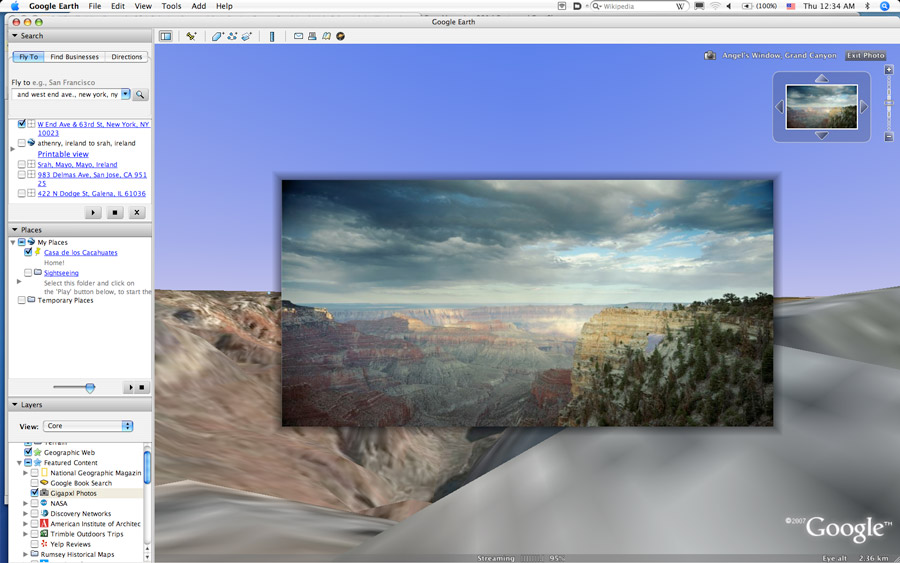
Gigapixel Adobe HQ now in Google Earth

Few people push Photoshop harder than the crew at the Gigapxl Project, creators of ultra-high resolution digital images and prints.  Now their work, including a shot of the Adobe HQ in San Jose, appears inside Google Earth.  You can zoom in from space onto individual images, then zoom way into each one.  Here’s a screenshot.

To check it out, download the latest version of the software.  Under "Layers" on left side, open the "featured content" folder, check the box for "Gigapxl Photos," and then look for the icons of a picture with a camera.  More details are in the Google Earth documentation.

Photographic pondering

Visions in Green

and wonderfully i fell through the green groove
of twilight striking into many a piece.  –ee cummings

I think the country of Ireland deserves its own color space: the famous “Forty Shades of Green” are a malachite manhandling of your optic nerves that can’t be done justice using the puny ProPhoto or anything else.  We need iRGB*–Irish RGB–with the capacity to describe hilariously green tones found nowhere else in nature.

In the meantime, here are my photos from Ireland.  Once you’ve clicked the gallery for the first time, you can move through the images using left and right arrow keys.  A few notes/thoughts:

  • Upside of asking a pro photographer friend for shooting/gear advice before a trip like this: He’ll offer good suggestions, such as bringing a graduated ND filter (which I wish I’d done).  Downside: He’ll show you images he took in the same spots, making you slap your forehead in dismay.  (Thanks a lot, Steve, ;-))
  • I continue to wish that Flash respected color profiles.  Because it doesn’t, the colors in the gallery are totally washed out**, at least on a Mac.  (Right-click/Cmd-click any one of them to see the difference, at least in Safari.)  We’ll keep working towards a solution.
  • I hate disrupting a scene using a flash, so I’m itching to replace my 17-85mm f4 lens with something comparable but faster.  The surprising thing (to me, anyway) is that Canon’s higher-end glass (e.g. the 24-70mm f2.8) doesn’t offer image stabilization.  I’m not sure why that is, or whether losing it would hurt images relative to my current lens.
  • Speaking of green grooves, we referred to various roadways as “green bobsled” tracks–emerald walls whipping by in disturbingly close proximity to one’s head.  Coming around a bend to find a Ford Focus leaning at a 45-degree angle, two wheels firmly up on a stone fence, was a useful cautionary moment.  In describing the trip to her folks, I overheard my wife say, “They drive like the English.” “No,” I interjected, “they drive like Evel Knievel.”  Sadly I couldn’t get any of this on film (er, sensor?).
  • Someday I’d love to try shooting “The Clash of the Ash,” hurling–“the world’s fastest field team sport.”  Unlike soccer/football, this is a game Americans could dig–not the kind of thing about which Stephen Colbert could quip, “I’ll help you tell the boring scoreless matches from the riveting scoreless matches.)

* Thanks to Outback Photo for the color space graphic.
** Here’s a screenshot from a new iPhoto gallery, comparing the identical images shown via Safari (above) to those shown via a Flash gallery (below).

Great black & white, New York at night, & more

Great black & white, New York at night, & more

Beware your metadata trail

…at least if you’re planning to commit crimes.  The British Times Online reports that the EXIF metadata embedded in digital camera images could be used to track down whoever photographed each page of the final Harry Potter novel & uploaded it prior to the book’s release:

The information, known as Exchangeable Image File Format (Exif) data, has already revealed that the camera used was a Canon Rebel 350. Because the model is three years old, the device would likely have been serviced at least once since it was purchased, in which case the owner’s name would be known. [Via]

The reality in this case, I think, is that identifying and prosecuting the shooter would be difficult.  The camera owner would have had to have registered the camera and have had it serviced, and even with a name authorities would have to demonstrate that the person then used the camera to photograph the pages and upload the results.

Still, it’s another interesting example of digital devices recording more fingerprints than most people expect.  As devices get smarter, they’ll leave a longer trail of breadcrumbs–for better and for worse.  (How much info must be contained in an image from a GPS-enabled cellphone camera, for example?)

Adobe often ends up in a tug of war: some people really want to make metadata secure, while others want easy ways to strip it away.  Photographers seem most sensitive in this regard, wanting to ensure that their copyright info is preserved, while optionally stripping out revealing details of how, when, and where an image was captured.  On other occasions I’ve heard law enforcement folks wish aloud that Photoshop automatically inserted some trackable info into each file based on serial number.  (Don’t worry: that’s been met with an immediate, “Um yeeeah, noooo…”)

In any case, I think there’s some low-hanging fruit here.  We should offer a simple script that would let Bridge remove metadata from images, trusting that most people would use it for good & not for evil.  If you have other suggestions, please let us know.

Airplane bones in HDR; more

Super fly:

Photography from the Four Corners

Time & space in photography

  • In honor of George Eastman‘s 153rd birthday (today), Slate features an interesting Magnum photo essay on the history of consumer picture-taking.
  • If Eastman were still with us, he’d make a great model for Mark Story’s Living in Three Centuries: The Face of Age. [Via]
  • Spanning 35 years to the day, Nick Ut brought the world a girl burned by napalm & a girl burned by herself.
  • Peter Kaplan shoots from great heights, including some eye-watering shots from atop World Trade Center. [Via]
  • Elsewhere in the air, in Me and My Human Vincent Laforet has captured a striking image from above the ice rink in Central Park.
  • Wired hosts selections from Edward Burtynsky‘s documentary about China’s superhuman rise & the human consequences thereof.  [Via David Harradine]

Time & space in photography

  • In honor of George Eastman‘s 153rd birthday (today), Slate features an interesting Magnum photo essay on the history of consumer picture-taking.
  • If Eastman were still with us, he’d make a great model for Mark Story’s Living in Three Centuries: The Face of Age. [Via]
  • Spanning 35 years to the day, Nick Ut brought the world a girl burned by napalm & a girl burned by herself.
  • Peter Kaplan shoots from great heights, including some eye-watering shots from atop World Trade Center. [Via]
  • Elsewhere in the air, in Me and My Human Vincent Laforet has captured a striking image from above the ice rink in Central Park.
  • Wired hosts selections from Edward Burtynsky‘s documentary about China’s superhuman rise & the human consequences thereof.  [Via David Harradine]

Sunday Photography: Keep your chimp-hand strong

I’ve recently come across some round-ups of great photos:

Blowin' up real good

While getting frozen yogurt the other night, I observed a posse* of little boys–maybe 5 or 6 years old–swarming around a small pink "Little Mermaid"-themed chair.  They were goading one of their little buddies to body slam himself into the chair, chanting "Dooo it, dooo it… Destroy IT, destroy IT!!"  Ah, the complete purity of that human impulse to see some stuff smashed all to hell.

In honor of today’s American holiday devoted, in some part, to that impulse:

  • Gene Gable features some cool vintage Fourth of July artwork on CreativePro.com.
  • Similar goodness comes from American U.  Go heavy or go home, right?
  • The NYT hosts a slideshow from explosives summer camp in Missouri. Adios, watermelon. (Here’s the accompanying article).
  • In the spirit of fire-breathing, wheel-popping patriotism, check out these shots from a Wisconsin tractor pull (recalling a little slice of my youth).  Not pictured: Sierra Club reps.
  • Not tied to the Fourth, but in the vein of vintage artwork, check out these fruit crate designs. [Via]  (See also previous.)
  • Update: For more bombs bursting in air, see Firework-Art.com. Man, all this really makes me miss summer car trips as a kid, where we could buy legally questionable goodies from web-footed Southerners by the roadside. [Via]

Happy (and grudgingly safe) Fourth,
J.

*What would the correct term (a la "pride of lions") be? Gaggle of boys? Hootenany? Fisticuff?

Tilt-shift photography, DIY tripods, and more

Weekend photography

A momentary lapse in time

Guns, kids, and salt

  • Magnum photographer Philip Jones Griffiths knows war.  He reflects on violence & its tools in this Guns and Kids photo essay presented by Slate.  The piece brings to mind these ladies–and these.
  • The subjects of It’s All Good couldn’t be less so–junkies, crackheads, gangsters and their families in NYC, "where escape is one rock, one shot, one Glock away."  Gallery. [Via]
  • PingMag interviews Edward Burtynsky, whose Manufactured Landscapes images chronicle humanity’s impact on the earth.  (Not long ago I kind of harshed on one of Burtynsky’s photos.  It certainly has more impact in the context of his larger efforts.)
  • Chris Jordan (mentioned recently) is using the synthetic world of Second Life to present his "Running the Numbers"–depicting the scale of human consumption.
  • The miniature City of Salt comes from Nicholas Kahn and Richard Selesnick–the photographers behind the similarly amazing Apollo Prophecies.
  • In Salt Dreams, Jimmy and Dena Katz chronicle the racers, rocketeers, and pink flamingos of the great Salt Flats.  More info is here. [Via]

Camera Raw 4.1 announced, due shortly

As you may have seen already, Adobe has announced Camera Raw 4.1, due to be available shortly via Adobe.com.  (The communication got out a little ahead of the actual plug-in, which should be posted in the next 24 hours or so.)

Camera Raw 4.1 adds support for 13 new digital cameras and backs, including the Canon EOS-1D Mark III, Fujifilm FinePix S5 Pro, Nikon D40x, Olympus E-410, Olympus SP-550 UZ, Sigma SD14, Phase One H 20, Phase One H 25, Phase One P 20, Phase One P 21, Phase One P 25, Phase One P 30 and Phase One P 45.

In addition, Camera Raw includes some very cool enhancements to sharpening & noise reduction.  I’ll share more details on these shortly; in the meantime, here’s a teaser screenshot.  (By the way, all the same controls will be coming to Lightroom soon, too.)

Scientific bits: Seadevils, severed arms, & Stephen Hawking

Scientific bits: Seadevils, severed arms, & Stephen Hawking

Apocalypse, memory, and redemption

  • In Dr. Strangelove Dr. Strangelove, Canadian Kristan Horton recreates shots from the film using everyday objects: "Silverware become an airplane, plastic and coffee grounds become the sky." Fantastic. [Via]
  • In a slightly related vein, Edward Zwakman produces large-scale photographs by painstakingly reconstructing objects and landscapes from memory. A bit more info is in his Tales from the Grid, but I’d like to know more.
  • Chris Jordan attempts to make staggering numbers comprehensible in his Running the Numbers: An American Self-Portrait.  By assembling thousands of photographs into large, intricately detailed prints, he depicts "a slow-motion apocalypse in progress."  See also the fascinating images of his earlier Intolerable Beauty. [Via]
  • Artist Amanda Vandermeer and photographer Paul O’Grady have collaborated to create Sustainable Jewellery, using flora & fauna to decorate the human form.  (Weirdly, there’s no permalink on the blog where the images appear, so you’ll need to scroll down to the relevant section.)  It might be interesting to see this work juxtaposed with Chrisopher Conte’s sculptures, such as this biomech arm or this stainless steel spider.

Sunday in black & white

It’s been far too long since I’ve gotten to share some photographic finds.  So, without further ado, here’s great stuff in black & white:

  • The Apollo Prophecies sounds fascinating: "This installation features a continuous ten inch by thirty-six foot long black and white panoramic photograph depicting astronauts from the 1960’s traveling to the moon and back. While on the lunar surface they discover a lost Edwardian expedition that may or may not be real. It was shot and assembled on sets or on location with miniature models and live actors."  Here’s a video about its creation, followed by larger detail images.  The long-snouted astronauts have a Hieronymus Bosch quality.
  • Through photog Tim Mantoani (who’s doing a really interesting project I’ll mention soon), I learned of rock n’ sports vet Michael Zagaris. Sports Shooter is hosting a gallery of his work (love the Bill Walsh/Joe Montana shot), and more is available to see and purchase on Michael’s site.
  • Jonathan Greenwald sets his portfolios to music.  Dig the "Ordinary Life" set, well paired with Coldplay.
  • Herman Krieger’s Mall-aise captures suburban anomie with visual & verbal puns. [Via]  On a somewhat related note, Stephen Crowley captures isolation at a rural motel.
  • SUNY Buffalo hosts a rather haunting gallery of early 20th century images from the Arkansas State Prison. [Via]
  • On Flickr folks are re-creating vintage photos of London.  See also the site’s Then & Now photo pool. [Via]
  • Apparently, in child portraiture, it was once common for mothers to disguise themselves as chairs. [Via]

Sunday in black & white

It’s been far too long since I’ve gotten to share some photographic finds.  So, without further ado, here’s great stuff in black & white:

  • The Apollo Prophecies sounds fascinating: "This installation features a continuous ten inch by thirty-six foot long black and white panoramic photograph depicting astronauts from the 1960’s traveling to the moon and back. While on the lunar surface they discover a lost Edwardian expedition that may or may not be real. It was shot and assembled on sets or on location with miniature models and live actors."  Here’s a video about its creation, followed by larger detail images.  The long-snouted astronauts have a Hieronymus Bosch quality.
  • Through photog Tim Mantoani (who’s doing a really interesting project I’ll mention soon), I learned of rock n’ sports vet Michael Zagaris. Sports Shooter is hosting a gallery of his work (love the Bill Walsh/Joe Montana shot), and more is available to see and purchase on Michael’s site.
  • Jonathan Greenwald sets his portfolios to music.  Dig the "Ordinary Life" set, well paired with Coldplay.
  • Herman Krieger’s Mall-aise captures suburban anomie with visual & verbal puns. [Via]  On a somewhat related note, Stephen Crowley captures isolation at a rural motel.
  • SUNY Buffalo hosts a rather haunting gallery of early 20th century images from the Arkansas State Prison. [Via]
  • On Flickr folks are re-creating vintage photos of London.  See also the site’s Then & Now photo pool. [Via]
  • Apparently, in child portraiture, it was once common for mothers to disguise themselves as chairs. [Via]

High Plains Drifting

I’m just back from the desert, and boy are my arms sandy… We gave our friend/my fellow Photoshop PM Bryan O’Neil Hughes a solid send-off to his single days, I think. Word to the wise : RV+sand = elephant+tar pit; oi vey. Sadly, I didn’t manage to see a real live Adobe Photo Shop [Via].  I did, however, find a great deal on California real estate in Trona.  (Hope you like sulfur… and breaking your windows just to cut your wrists.)  Ballarat Bob was MIA, but we caught up with our friend, the Mayor of Ballarat, along with his even more grizzled (!) dad–keepers of Charlie Manson’s truck & black helicopters; here’s a small gallery

Their one-room building (famous for $2 cans of Milwaukee’s Best–which will taste good to you when it gets hot enough) also features a photo I really love.  I don’t know a thing about its subject or its history, and I always choose not to ask.  Sometimes it’s good to savor a little mystery.

In a photographic vein, and starting with Death Valley:

  • Author & photog Ben Long is just back from the park as well, and he’s posted a gallery of terrific shots.
  • If the boys of Ballarat were ever to go digital, they might like the Kodak 1881: a digital camera as vintage locket. [Via]
  • "You just had to run": TOP relays an anecdote from Steven Spielberg on catching the dawn for Empire of the Sun.
  • Author Will Self has documented his writing room, festooned with Post-It notes.  (I feel like he’s got a physical version of my copy of Contribute, from which I write this blog.  It’s a warren of ideas and links, jotted in blurbs, competing for too little time.) [Via]

Check out the thorax on that guy

I’m a real lightweight when it comes to insects (for example, I could never name my Flash rival after one ;-)), but they do inspire creative photography & more:

  • Buzz illustrates "The Intimate Bond Between Humans and Insects" via some amazing microscopic photography. See inside. [Via]
  • Student photographer Lawraa shares a shot of a praying mantis apparently listening to Snoop ("Throw your prehensile appendages in the ai-ir…") [Via]
  • Der Spiegel had a great gallery of shattered bugs, but now I’ve waited too long and it’s returning a 404 error.  Dang–maybe it’ll turn up elsewhere, as the images were worth seeing. The best the site will now give me is a pregnant cow scaring chubby cyclists.
  • Make any treat more mouthwatering with the help of sugar that looks like ants. [Via]
  • In a similar vein, an ad campaign uses ants–"the most credible ambassadors for sweetness*"– to show off sugar-free eats.
  • [For more bug life, see previous.]

*Snuggle the fabric softener bear was apparently unavailable

Swords, plowshares, photos & art

  • Armed America photographs some of those who own the nation’s ~200 million firearms, sharing bits of their perspectives.
  • Armed Appalachians appear in Shelby Lee Adams’s Napier Family series.
  • Slate features Gitmo in Black and White, a Magnum photographers’ slideshow documenting the prisoner detention center at Guantanamo Bay.  (If there’s a more surreal location for a Starbucks, I’ve yet to hear it.)
  • Juxtaposing wealth & war, this image from Lebanon was named "Photo of the Year 2006" by World Press Photo.  There’s more info in this NPR story (which for whatever reason won’t play on my Mac). [Via]
  • Unflinching war photographer James Nachtwey has been honored at the TED Conference.  They’ve created a video discussing his & others’ work, and Nachtwey is covered in the documentary War Photographer (3-minute excerpt). [Via]
  • Hoping for a more peaceful world, Retired Weapons depicts another future for military hardware.  (I hoped for a bit more from this one, but maybe it’s deeper than I’m seeing.) [Via]
  • Lastly, a reason to go bigger than Shuffle: this iPod saved a soldier’s life.