The team at The Mill have rigged up an iPhone in a novel way in service of City Harvest. First, check out the finished product:
Then see this brief making-of:
FreshDV has a bit more back story. Super cool. [Via Stu Maschwitz]
Category Archives: 3D
Video: Rapid creation of 3D using a video camera
Check out this bit of cleverness:
It reminds me of a more automated version of the Video Trace technology (see demo) that popped up around two years ago. It also brings to mind Strata’s Foto 3D, a tool for generating 3D models from within Photoshop using just a series of photographs.
I know Photoshop’s entry into 3D can sometimes be a little confusing (e.g. wasn’t the app big/complex enough already?), but we see 3D becoming more and more accessible & ubiquitous. It’s not a question of “if” but “when.” For more info you may want to see “Photoshop 3D is not about 3D.”
Tilt-shifting in AIR; Slick, simple 3D
- Developer Art & Mobile has created TiltShift Generator, a simple little Flash app that lets you selectively blur parts of an image, simulating very shallow depth of field. You can download the app for use outside your browser, too. [Via Rich Townsend]
- Box Shot 3D is a very simple, very easy-to-use little app for mapping images onto common 3D objects (boxes, bottles, business cards, etc.), then rendering a nicely lit result; see screenshots. I downloaded a copy and got good results in a minute or two.
Bert Monroy speaking to SF PUG May 14
Master digital painter Bert Monroy will be presenting his work & techniques at the San Francisco Photoshop User Group meeting May 14. In addition to showing his traditional 2D methods,
Bert will also show new exciting 3D workflows for creative designers who want to learn about Photoshop CS4 Extended’s 3D capabilities. There are many simple 3D effects one can use for many different creative outputs that many people aren’t aware of and Bert will wow us with these techniques.
I caught Bert’s presentation on the topic at Photoshop World & can vouch for the strong audience reaction. Check out the SF PUG event page for complete details. [Via Jeff Tranberry]
3D Invigorator comes to Photoshop
At NAB this week I got to chat with Zax Dow, creator of the new 3D Invigorator plug-in for Photoshop. The tool is based on Zaxwerks’ mature 3D Invigorator for After Effects. According to the company,
3D Invigorator for Photoshop allows you to create complex 3D objects using Adobe Illustrator files and fonts. You can easily model 3D objects based on the vector files, adding depth, bevels, and other 3D features. The drag and drop materials makes it simple to apply reflective, transparent, or bump mapped textures to your objects. You can combine textures, adjust the position of the textures, and add multiple lights to give every 3D object a different look.
Although the plug-in doesn’t (yet) create native 3D layers in Photoshop, it works with Smart Objects, meaning you can go back and modify 3D geometry, lighting, etc. The tool costs $199, supports Photoshop CS2-CS4 on Mac & Windows, and is available for download as a tryout from Digital Anarchy’s site.
Tangentially related: Corey Barker of NAPP points out that Archive3D.net “offers an enormous collection of free 3D models in a number of different categories.”
Script facilitates 3D file handling in Photoshop
Did you know that you can browse & download thousands of free 3D models right inside Photoshop? Yeah, there’s all kinds of cool, obscure stuff like that hanging around.
In any case, some people have reported hitting a problem where files from Google’s 3D Warehouse–or other Collada-format files–are imported into Photoshop fully or partially invisible. This happens because many Collada exporters invert the opacities in materials (meaning that 100% opaque will come in at 0% & thus be invisible). If you hit one of these files, try running this script to invert the opacities in your model’s materials. (For reference here’s the official tech doc.)
Electric Rain finds success with Configurator
“Goodbye seven-click, menu-driven plug-in launch…hello single-click access to 3D joy.” I’m really glad to see that Electric Rain has enhanced the usability of their Swift 3D.PS 3D plug-in for Photoshop by leveraging Flash panels & Adobe Configurator. On their site they posted a detailed overview of the panel creation process and benefits. Good stuff, guys.
Speaking of Configurator, thanks to all the folks who attended the Photoshop extensibility sessions that Jeff Tranberry, Tom Ruark, and I presented last week at Photoshop World. By popular demand Jeff has posted his slides alongside lots of other detailed notes on panel creation. More ambitious Configurator users will want to check out his notes on combining scripts with Configurator panels, including some details on how to package up external files using Extension Manager.
Great CGI storytelling
Here’s a little inspiration for your Friday. Filmmaker Bruce Branit has created World Builder, in which “a strange man builds a world using holographic tools for the woman he loves.” I’ve embedded it below, but it’s worth hitting the full-screen viewing button (next to the Vimeo logo).
This is how smooth and effortless I’d like Photoshop to feel.
Bruce was one half of the two-man team that produced the excellent 405: The Movie on their desktop computers back in 2000 (more info). Thanks to reader Cris DeRaud for the link.
Sunday Type: Comics, zombies, & more
- Poor Papyrus: It’s on the hit list of this Simple Pledge. (Man, next thing you know, photographers will be told that black jeans & fanny packs are on the way out.)
- “We meet again, my dear doctor…” Blambot presents a detailed but accessible survey of Comics Grammar & Traditions. [Via]
- Graphic Mania features a roundup of fresh 3D typography. The fountain of type for the Zune Marketplace sorts me out.
- “Nazi Zombies!!” Austin, you have been warned.
Fun with Augmented Reality
Wikipedia describes “augmented reality” as “the combination of real-world and computer-generated data (virtual reality), where computer graphics objects are blended into real footage in real time.” Now it’s come to Flash, with some amazing results.
The GE Smart Grid site lets you print out a sheet of paper, hold it up to your Web cam, and interact with 3D graphics. I was all set to link to a quick demo of the technology, but it just went MIA from YouTube. No matter: here’s a demo of an interactive print piece for Mini:
Thanks to the open-source FLARtoolkit for Flash, augmented reality is popping up all over, as in this augmented Happy New Year’s card:
It’s even been combined with Twitter + t-shirt printing. For more info, check out David Pogue’s report from TED. [Via lots and lots of people]
Tangentially related: This funny example of “real-life multitouch” is, indeed, a sign of too much iPhone usage. (Seeing it reminds me of Photoshop QE Pete du’Fosse realizing that he was working too much when he found himself hovering a hand over his microwave’s keypad, getting frustrated when no tool tip appeared.)
New Photoshop plug-in creates & edits true 3D text and more
I’m very excited to see that Electric Rain has released Swift3D PS, a plug-in that lets you create & edit 3D layers within Photoshop CS4 Extended. According to their site, top features let you:
- Create, bevel and extrude 3D text from any font in seconds.
- Quickly create extrusions and 3D lathe objects with a Bézier pen tool.
- Extend Photoshop’s workflow with After Effects CS4 Live 3D view.
- Import, extrude and bevel existing 2D vector artwork from Illustrator or Flash.
- Simplify 3D scene creation with targeted cameras & lighting.
Because it works inside Photoshop, the plug-in taps into the power and flexibility of Photoshop’s 3D system. After extruding some text, for example, you can still apply Smart Filters in Photoshop, paint the surface of the letters, rotate them directly in PS, and send them back to the plug-in for further updates.
Very cool; I’ve been hoping to see something like this for a long time. Swift3D PS should make it much faster and easier to create popular 3D text effects (like this) & more.
Check out some screenshots, and peep these 3-minute tutorials to see the system in action. The plug-in (Windows only at the moment) is downloadable in trial form and sells for $149 (with a 15% off coupon available now).
Update: What the heck, here’s a sample video (3 minutes):
Lenticular adventures in CS4
One of the subtleties of Photoshop CS4 Extended‘s 3D support is the
way it facilitates creation of images for use in lenticular printing. According to Wikipedia,
Lenticular printing is a technology in which a lenticular lens is used to produce images with an illusion of depth, or the ability to change or move as the image is viewed from different angles. Examples of lenticular printing include prizes given in Cracker Jack snack boxes that showed flip and animation effects such as winking eyes, and modern airport advertising graphics that change their message depending on the viewing angle… Recent advances in large-format presses have allowed for oversized lenses to be used in lithographic lenticular printing.
Adobe evangelist Russell Brown has gotten really excited about using Photoshop to enable creation of lenticular prints, and he’s posted a great set of tutorials and sample files to help get you up to speed. Even better, he’s used the forthcoming Configurator utility to create a panel (see screenshot) that walks you through the steps and actually executes them on demand, right within Photoshop. Super cool.

Cool recent tech: Lifelike 3D, image detection, & more
I’m more than a little snowed under right now with preparations for next week’s announcement, but I wanted to share a few interesting finds:
- Photographers are always asking for better ways to prevent misuse of their works, and TinEye promises to help by using image-recognition techniques to find images in the wild. Ars Technica’s got details.
- I’m delighted to see that Cooliris, the very cool browser technology formerly known as PicLens (see previous raving), is available once again for Safari. I’d forgotten how much I missed it until it returned recently. The developers are also offering an embeddable Flash-powered version for use on your own sites.
- 3D technology is getting waaay too realistic these days. [Via Daniel Presedo & Zorana Gee] Tangentially related?: Disney Lab Unveils Its Latest Line Of Genetically Engineered Child Stars.
Cool recent tech: Lifelike 3D, image detection, & more
I’m more than a little snowed under right now with preparations for next week’s announcement, but I wanted to share a few interesting finds:
- Photographers are always asking for better ways to prevent misuse of their works, and TinEye promises to help by using image-recognition techniques to find images in the wild. Ars Technica’s got details.
- I’m delighted to see that Cooliris, the very cool browser technology formerly known as PicLens (see previous raving), is available once again for Safari. I’d forgotten how much I missed it until it returned recently. The developers are also offering an embeddable Flash-powered version for use on your own sites.
- 3D technology is getting waaay too realistic these days. [Via Daniel Presedo & Zorana Gee] Tangentially related?: Disney Lab Unveils Its Latest Line Of Genetically Engineered Child Stars.
Photoshop 3D is not about 3D
Or rather, it’s not just about 3D. But let me back up a second.
Remember the Newton? My first week at Adobe, I attended an outside "how to be a product manager" seminar at which the Newton was held up as a cautionary tale. The speaker pointed out that the product’s one critical feature–the thing on which everything else depended–was a handwriting recognition system that sucked at recognizing handwriting. Among many other things, the Newton also featured a thermometer. Customers, according to the speaker, had a conniption: what the hell were the product designers thinking, getting distracted with stuff like a thermometer when they couldn’t get the foundation right?
The moral, obviously, is that if you’re going to branch into new territory, you’d better have made your core offering rock solid. And even if it is solid, some customers may perceive any new work as coming at their expense.
I worry a bit about Photoshop users seeing the app branch into 3D and thinking we’ve taken our eye off the ball. Earlier this week reader Jon Padilla commented, "Some of my disgruntled co-workers grumbled ‘oh great! a bunch of cool features we’ll never learn to use…’" No matter what Photoshop adds specifically for your needs, the presence of other features can make it easy to say, "That looks like a great product… for someone else."
Obviously we care about improving the way Photoshop gets used in 3D workflows, especially around compositing and texture painting. If that’s all we had in mind, however, I think we would be overdoing our investment in 3D features relative to others. As it happens, our roadmap is broad and ambitious, so let me try to give some perspective:
- At root, Photoshop’s 3D engine is a mechanism that runs programs on a layer, non-destructively and in the context of the Photoshop layer stack. At the moment it’s geared towards manipulating geometry, shading surfaces, etc., but shader code can perform a wide range of imaging operations.
- Features that work on 3D data–being able to create & adjust lights, adjust textures and reflectivity, paint on transformed surfaces, etc.–work on 2D data as well. (Wouldn’t it be nice to have Lighting Effects written in this century?)
- As photographers finally tire of chasing Yet More Megapixels, cameras will differentiate themselves in new ways, such as by adding depth-sensing technology that records 3D data about a scene. The same infrastructure needed for working with synthetic 3D objects (e.g. adjustable lighting, raytracing) can help composite together photographic data.
- The field of photogrammetry–measuring objects using multiple 2D photos–is taking off, fueled by the ease with which we can now capture and analyze multiple images of a scene. The more Photoshop can learn about the three-dimensional structure of a scene, the more effectively it can manipulate image data.
I know I’m not providing a lot of specifics, but the upshot is that we expect Photoshop’s 3D plumbing to be used for a whole lot more than spinning Coke cans and painting onto dinosaurs. Rather than being a thermometer on a Newton, it’s a core investment that should open a lot of new doors over many years ahead, and for a very wide range of customers.
LightWave Rendition for Photoshop now shipping
The folks at NewTek are now shipping Lightwave Rendition, their 3D lighting and rendering add-on for Photoshop Extended. According to the press release:
The resulting output delivers a high-quality, photo-realistic image, all from within the Photoshop Extended environment.
LightWave Rendition ships with sample projects and a library of 3D model art. The product also includes support for 3D models from a variety of applications, including LightWave 3D, Google™ SketchUp’s 3D Warehouse or many readily available 3D formats. It includes:
- Slider Controls for Render and Anti-Alias Quality, allowing for quick preview renders up to photo-quality images.
- Material Presets for the option to apply a preset material or any selected Photoshop materials to the surface of your 3D object for complete flexibility in design.
- Light Environments open the use of the default Photoshop Extended lighting environment or users can add to the power of LightWave Rendition for Adobe Photoshop by using any 2D layer as a light map for complete control of the final light environment.
The product is $149 for Mac and Windows & is available for purchase and download from the NewTek site.
LightWave Rendition adds new 3D power to Photoshop
I’m pleased to see that NewTek, the folks behind the LightWave 3D modeling, animation, and rendering package, have announced a new product, LightWave Rendition for Photoshop. This plug-in technology builds on the 3D file format support in Photoshop CS3 Extended, adding on high-quality rendering and lighting manipulation. In this screenshot they show an image as displayed by Photoshop’s built-in renderer, then hit with the LightWave renderer & touched up in Photoshop. Here’s a second example.
According to their marketing docs, LightWave Rendition for Photoshop includes:
- Slider Controls for Render and Anti-Alias Quality: Allows for quick preview renders up to photo-quality images.
- Material Preset: You have the option to apply preset or selected Photoshop materials to the surface of your 3D object for complete flexibility in design.
- Light Environment: Use the default Photoshop Extended lighting environment or add the power of LightWave Rendition for Adobe Photoshop by using any 2D layer as a light map for complete control of the final light environment.
Because the product is in beta form, you can buy it now for $99, discounted from the normal price of $149. The discount ends when the beta does.
For more cool 3D add-ons to Photoshop, see previous announcements from Strata & Daz3D.
3D text goodness
- Marion Bataille’s ABC3D popup book looks terrific; here’s a video of cruising through the pages. [Via]
- You The Designer features 25 Tasty 3D Graphic Design Treats, all centered around lettering.
Side note: I keep trying to tell developers that I think there’s an opportunity to knock together a very simple 3D extrusion/adjustment environment as a Photoshop plug-in, leveraging PS CS3 Extended’s ability to manipulate 3D layers. No one has yet seized the opportunity, but I’ll keep trying.
No, seriously, you *do* suck at Photoshop…
Heh–in the vein of sites like AwfulPlasticSurgery.com, now we’ve got the Photoshop Disasters blog–chock full of image manipulation mishaps. It’s good to indulge in a little schadenfreude now and then, and with phrases like “the culturally-ravaged, post-wardrobe-malfunction neo-fundamentalist, sexual dystopia we live in,” it has to be good. (Wasn’t that the Smucker’s slogan?) [Via Lori Grunin]
Speaking of sucking, You Suck at Photoshop #8 has been posted, getting Fergilicious with 3D layers.
Naked saunas, 3D Flash globes, and other infographic goodness
- My wife and I are nervously quizzing each other on these expert (and very funny) baby care instructions (boosted wholesale, it would seem, from David Sopp’s Safe Baby Handling Tips). [Via]
- Wable is “a coffee table that displays a user’s web activity via physical bar graphing.” Yes, I remember pining for such a thing not ever. (Are Venn-diagram kiddie pools next?)
- Maps:
- Concentric circles are coming for us!! The Onion has fun with news infographics.
- Seeking to place events into geographical context, Yahoo has created a 3D NewsGlobe using Adobe Flex. ComputerWorld’s got background on the project. [Via]
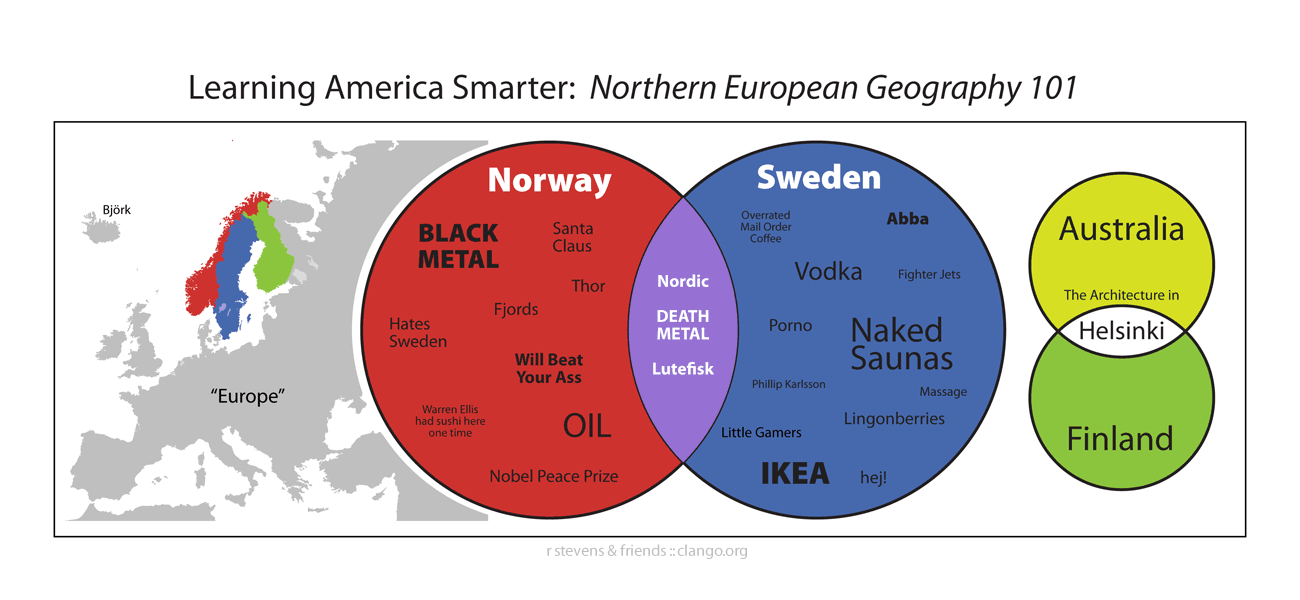
- In similar vein of “Learning America Smarter,” check out the naked saunas, black metal, and ass-beating of Scandinavia. (And you thought it was all chilling out with MDF.) [Via]
- The Gough Map is said to be the oldest accurate map of Britain, dating from around 1360.
- Signage:
- My little brother Ted let me ride along last month as he drove his garbage truck. This safeyman image (somewhat dodgy iPhone-cam quality, sorry) I snapped in his cab shows the truck really putting the “screw” back in “screw of Archimedes.”
- “Do not iron while wearing shirt (on an iron-on decal)”: more good advice from the safetyman chronicles. [Via]
- I can get behind this “Faith healing sign” at Disneyland, not to mention Serbian children escaping a triangle.[Via]
- Blogging software has made self-publishing seem simple, but beneath the covers, a whole lot’s going on. Wired has a Flash-based diagram showing what all happens when one hits “Publish.” [Via]

Recent Flash goodness in 3D & beyond
- When is a shopping site… something else? When it’s this viral site for Dutch chain Hema*. "It’s like an IKEA catalog was sliced up and fed to a Rube Goldberg machine," says Motionographer. "The magnifying glass bit is brilliant." [Via]
- Who doesn’t like "secret interactive frivolity"? Design firm Baker and Hill lavishes attention on the details of their fun-to-navigate company site.
- 3D action:
- Don’t let the ultra-retro intro fool you: Electric Oyster’s demo features the beginnings of a nifty Flash-based flight simulator. [Via]
- National Geographic offers a 3D Atlas of Human History. Developer g.wygonik from the always-interesting Terra Incognita provides background on the project.
- This Adobe Japan page features 3D balls gone mad. [Via]
- The Volvo XC70 site features a fully rotatable rendering of the car, festooned wih interactive touch points. Stick around through the intro, then hit the arrows to continue. (Yes, we have kid-haulers on the brain, and I’ll always have a thing for Volvo wagons.)
- ASLuv busts out the fairy dust with this little particle sprayer. (Don’t break the glowsticks ’til you feel the beats hit.) [Via]
- In a sorta related vein, see Lee Brimelow’s YTMND-style Billy Mays tribute. Puzzling; I can dig it.
- The Air Pocket Symphony (no relation to Adobe AIR, MacBook Air, wayward heiresses, etc.) features photorealistic objects and a nice, simple sliding animation. [Via]
- MyFlashFetish offers SWF bits (particularly music players, it seems) that can be embedded in your site. [Via]
* Tangential: It’s not Flash, but on the innovative shopping front, software maker Panic lets you drag and drop items into your shopping cart. Slickness.
Recent Flash goodness in 3D & beyond
- When is a shopping site… something else? When it’s this viral site for Dutch chain Hema*. "It’s like an IKEA catalog was sliced up and fed to a Rube Goldberg machine," says Motionographer. "The magnifying glass bit is brilliant." [Via]
- Who doesn’t like "secret interactive frivolity"? Design firm Baker and Hill lavishes attention on the details of their fun-to-navigate company site.
- 3D action:
- Don’t let the ultra-retro intro fool you: Electric Oyster’s demo features the beginnings of a nifty Flash-based flight simulator. [Via]
- National Geographic offers a 3D Atlas of Human History. Developer g.wygonik from the always-interesting Terra Incognita provides background on the project.
- This Adobe Japan page features 3D balls gone mad. [Via]
- The Volvo XC70 site features a fully rotatable rendering of the car, festooned wih interactive touch points. Stick around through the intro, then hit the arrows to continue. (Yes, we have kid-haulers on the brain, and I’ll always have a thing for Volvo wagons.)
- ASLuv busts out the fairy dust with this little particle sprayer. (Don’t break the glowsticks ’til you feel the beats hit.) [Via]
- In a sorta related vein, see Lee Brimelow’s YTMND-style Billy Mays tribute. Puzzling; I can dig it.
- The Air Pocket Symphony (no relation to Adobe AIR, MacBook Air, wayward heiresses, etc.) features photorealistic objects and a nice, simple sliding animation. [Via]
- MyFlashFetish offers SWF bits (particularly music players, it seems) that can be embedded in your site. [Via]
* Tangential: It’s not Flash, but on the innovative shopping front, software maker Panic lets you drag and drop items into your shopping cart. Slickness.
New 3D Photoshop plug-ins
Great news: Developers are building on top of the 3D features in Photoshop CS3 Extended to deliver some great solutions. In just the last week we’ve seen a flurry of announcments:
- DAZ 3D has announced a beta of 3D Bridge for Photoshop, a connecter between DAZ’s free DAZ Studio 3D editing app & Photoshop. [Via]
- Strata has upgraded the Strata CX Suite.
- 3Dlayer.com has launched to provide expert tips & news specifically tailored to using 3D inside Photoshop.
According to the DAZ launch announcement, their tool lets you:
- View 3D scenes as Photoshop layers
- Change objects and figures simultaneously
- Render directly into Photoshop
- Import, export and modify image maps and textures onto 3D models in Photoshop
- Composite 2D and 3D content seamlessly
- Access DAZ’s full library of quality 3D content [DAZ gives away the editing application & sells adjustable content]
As for the Strata news, "In a nutshell, the technology from Strata’s 3D[in] plug-ins for Photoshop CS 3 Extended is now integrated into the Suite," says the crew on 3Dlayer.com. With it you can:
- Send a 3D model to PS as a 3D layer
- Send a finished rendering to PS as separate layers (shadow layer, reflection layer, color layer, etc)
- Send a PS image to a 3D background for tracing or placement
- Send a 3D model direct from PS to PDF or HTML and it embeds the 3D object (you read that correctly)
- Link PS files as 3D textures – changes made are automatically updated in the 3D texture
Good stuff all around. We think that 3D in CS3 Extended is a big step forward, and of course we’re not planning to rest on those laurels. I love seeing great developers like Strata and DAZ jump on the opportunity to help enrich the story.
By the way, did you know that you can browse the Google 3D Warehouse right from within Photoshop CS3 Extended? Here’s more info. Also, Adobe’s Steve Whatley mentions that Adobe is on tour with Maxon, showing off 3D integration between the tools.
Crazy-fast 3D slideshows for Flickr, Facebook, more
Several times now I’ve expressed my appreciation for PicLens, a beautiful (and free) little browser plug-in that enables full-screen, hardware-accelerated slideshows from Google Images, Flickr, MySpace, deviantART, and other sites. It’s changed my whole online photo viewing experience.
Now Alec from PicLens writes to say that there’s a new version available for Firefox (Safari & IE updates to follow):
It features the all-new “3D Wall,” a magical virtual interface that can exhibit 100s, if not 1000s of images. There, you can drag, scroll, zoom, and, of course, jump into full-screen mode. You’ll have to try it out to really experience it. It brings the user one step closer to a fully immersive multimedia experience on the Web.
Once you download the 1MB plug-in (Mac or Win), go into a slideshow and try holding down and arrow key to cruise through the images. I’d take a screenshot, but it doesn’t seem to get along with Snapz Pro. [Update: Here’s one, though it doesn’t capture the motion.] Really nicely done, guys!

[Update: Matthew from The Turning Gate has updated his free TTG Slimbox Gallery for Lightroom to offer PicLens compatibility. I’ve confirmed that it does indeed work, provided you upload the exported gallery to a Web server.]
Wicked cool: Building a 3D model from video
Here’s something pretty well guaranteed to put a smile on your face, I think: the Australian Centre for Visual Technologies has developed VideoTrace, "a system for interactively generating realistic 3D models of objects from video." A user sketches a few surfaces, after which the system works to generate 3D data. The short video demonstration is a little ho-hum until near the middle, which is where the uncontested smiling begins. 😉 [Via]
This demo makes me think of Strata’s Foto 3D, a tool for generating 3D models from within Photoshop, using just a series of photographs. By placing an object onto a specially printed piece of paper, then shooting it from a variety of angles, you give the software enough info to generate a 3D model that can then live as a 3D layer in Photoshop CS3 Extended.
It also reminds me of Extended’s ability to set 3D planes on a photograph using its Vanishing Point plug-in, then export the results as 3D data for use in After Effects and other tools. With it you can export an image like this as 3D data, then set camera movement in AE and create an animation like this.

Recent Flash coolness
Some bits I’ve encountered in recent travels:
- Mr. Doob is out of hand, creating all kinds of cool Flash experiments, 3D and otherwise. From the fireworks on the home page to a blog full of examples, the guy is keeping busy. I especially like this 3D cube and these spheres, both showing off depth-of-field effects enabled by Papervision 3D. This little fluid simulation is fun, too (reload the page to reconfigure the pieces).
- ClaraCollins.com presents the fashion designer’s work in a novel way. Mouse over the little arrows that sit above the pages of each portfolio, and you’ll see the images whip by in little time lapses. You can also rotate each portfolio 180 degrees. [Via]
- Layer Tennis comes to Flash in a friendly clash between James Hutchinson & Trevor Van Meter. [Via]
- Reminding me why I could afford only 120 sq. ft. in Manhattan (hello, Brooklyn!), 5th on the Park offers 1,800 sq. ft. in Harlem–for a cool $1.6 mil. I mention it here because of the cool presentation of the building & its units. You can roll over each face of the structure, clicking any unit to see its floor plan & other details. [Via]
- Art Is A Gift uses a Flash UI to let you style a little "Baby Qee" critter. Check out the gallery section, as well as the "About" link that shows kids painting the real thing as art therapy. [Via Jeff Tranberry]
- Enfant Terrible sets off its shopping site with a cheerful, simple little animated illustration. [Via]
- Adobe has created a 25th Anniversary Timeline of the company, on which you can see key developments in people, personnel, and the industry at a whole. I’m undecided as to how successfully I think the sort of "mystery meat" rollover approach works. There’s also a Flash-based 15-page overview document, complete with embedded video. (Weirdly I don’t see a downloadable PDF version.)
Tasty new automotive 3D animation
- Nissan has launched its Rogue crossover vehicle with the help of a really nicely executed drive through a swiftly tilting city. [Via] They play off the ad via their Web site, featuring more animation & a fistful of Flash games.
- Carmaker Mini has launched their Mini Clubman model via some solid Flash video + interactivity. [Via]
- Joseph Kosinski & Gmunk have teamed up to create the expertly rendered Hummer: Game On. Oh yeah, dude–the environment gets so totally pwned!! (Sorry, had to say it.) [Via]
- Tangentially related: Apparently Joseph will be remaking Tron (PDF). For Honda’s excellent take on Tron, see previous.
Adobe's 3D raytracing in the news
As I’m sure you know, we’re pretty excited to have 3D capabilities inside Photoshop CS3 Extended. That said, we know that what’s there today is really a first step into a pretty big realm.
Giving a glimpse into what the future might hold, the MIT Technology Review talks about Adobe’s research into real-time raytracing. In a nutshell, says principal scientist Gavin Miller, "Adobe’s research goal is to discover the algorithms that enhance ray-tracing performance and make it accessible to consumers in near real-time form."
These techniques scale particularly well on multi-core systems, which is why you tend to see rendering tests show up in high-end machines’ benchmarks. A brief slideshow accompanying the article demonstrates the differences between ray-traced images & those produced by the kind of interactive renderer used in Photoshop CS3. [Via Aravind Krishnaswamy, who works in Gavin’s group]
"Scanners," minus the exploding heads
Adobe’s own Russell Brown took his 3D head-scanning show (see previous) on the road to Photoshop World in Las Vegas this month. Not only could attendees get their heads scanned & turned into 3D models for use in Photoshop CS3 Extended; they could get the resulting skin texture files printed onto fabric. Scott Kelby volunteered to make sure the apparatus was safe (video), only to have his head printed onto a football that was kicked into the audience. Here’s a quick gallery featuring some deeply disturbing imagery ;-).
"Scanners," minus the exploding heads
Adobe’s own Russell Brown took his 3D head-scanning show (see previous) on the road to Photoshop World in Las Vegas this month. Not only could attendees get their heads scanned & turned into 3D models for use in Photoshop CS3 Extended; they could get the resulting skin texture files printed onto fabric. Scott Kelby volunteered to make sure the apparatus was safe (video), only to have his head printed onto a football that was kicked into the audience. Here’s a quick gallery featuring some deeply disturbing imagery ;-).
Killer Veggies From Outer Space, + more 3D
- Most Intimidating. Salad. Ever. Artist Till Nowak has rendered an Alien xenomorph out of vegetables. His behind-the-scenes PDF is worth a look as well, especially if you’re interested in 3D techniques. [Via] In a slightly related vein, the boys at JibJab have posted a collection of substantially friendlier sandwich art. (Not sure who created these; the photo set has been going around as one of those things that gets forwarded by one’s mom.) [Via]
- At the upcoming Photoshop World, Russell Brown will be scanning attendees’ heads & making them into pillows. Seriously. Madness will ensue. 🙂
- NVIDIA has produced an eye-popping real-time skin rendering demo. Check out the video. [Via Pete Falco]
- Pepakura Designer is a tool for for 3D papercraft. Pepakura is not a modelling app; rather, it converts 3D models into 2D designs that you can print out, then assemble into papercraft creations. The gallery features some impressive models, such as Cláudio Dias’s paper McLaren. [Via Florian Krüsch]
- Speaking of 3D cars, check out Zerone’s fine renderings. [Via]
- Plushie is "an interactive system that allows nonprofessional users to design their own original plush toys." Check out its novel interface for sculpting blobs–something even kids can use. [Via Nikolai Svakhin]
3D cars, in Flash & otherwise
- Carlos Ulloa has made an interactive 3D car in Flash, using Papervision3D. Bitchin’! [Via]
- CG-Cars.com features some kick-ass car modeling. Among all the eye-popping goodness (e.g. this guy), I love that someone modeled and posted a decrepit Yugo. [Via].
- For a counterpoint to the glam whips, see also Wrecked Exotics (which are, unfortunately, quite real). [Via]
- The words of Dylan Thomas instill a perfect lull in this Volkswagen night driving ad.
- Photog John Adams has captured a sweet HDR hot rod. [Via Photoshop Elements engineer Gary Cohen’s Flickr Ticker side project.] Elsewhere I came across this HDR 300Z. [Via]
- Dispensing with fluff & booth babes, the EyesOn design show is by car designers, for car designers. [Via]
- I can dig these cars floating on water, along with this train. [Via]
3D cars, in Flash & otherwise
- Carlos Ulloa has made an interactive 3D car in Flash, using Papervision3D. Bitchin’! [Via]
- CG-Cars.com features some kick-ass car modeling. Among all the eye-popping goodness (e.g. this guy), I love that someone modeled and posted a decrepit Yugo. [Via].
- For a counterpoint to the glam whips, see also Wrecked Exotics (which are, unfortunately, quite real). [Via]
- The words of Dylan Thomas instill a perfect lull in this Volkswagen night driving ad.
- Photog John Adams has captured a sweet HDR hot rod. [Via Photoshop Elements engineer Gary Cohen’s Flickr Ticker side project.] Elsewhere I came across this HDR 300Z. [Via]
- Dispensing with fluff & booth babes, the EyesOn design show is by car designers, for car designers. [Via]
- I can dig these cars floating on water, along with this train. [Via]
Adobe peeps talk 3D at Apple tomorrow
If you’re in the Bay Area and are interested in the technical details of some of Photoshop CS3’s advanced features (3D, auto-alignment, etc.), swing by the Apple campus (De Anza 3, specifically) tomorrow night for a meeting of the Silicon Valley SIGGRAPH chapter. Refreshments roll out at 7:30, and the talk begins at 8pm. It’s five bucks for non-members, free for students. Details below.
Abstract
Ashley Still and Pete Falco of Adobe will give an overview of some of the new features in Photoshop CS3 Extended, including movie paint, 3D, and automatic alignment and blending of multiple images. In addition to demonstrating these new features, they will provide an overview of the Photoshop 3D Plug-in SDK that can be used to extend the current capabilities. There will be ample time for Q&A.
Speaker Bios
Pete Falco is currently Sr. Computer Scientist for Adobe Photoshop. Pete has been on the Photoshop team since 2005 and is focused on 3D and technology transfer for Photoshop. Prior to joining Adobe, Pete worked as an engineer on QuickTime VR at Apple, as the Director of Engineering at Live Picture and co-founded Zoomify. He holds a BS and ME from Rensselaer Polytechnic Institute.
Ashley Still is currently Sr. Product Manager for Adobe Photoshop. Ashley has been on the Photoshop team since 2004 and is focused on new markets and advanced technologies for Photoshop. Prior to joining Adobe, Ashley worked with an Entrepreneur in Residence at Sutter Hill Ventures developing and evaluating business plans and at eCircles.com, one of the first online sites offering photo-sharing and editing. She holds a BA from Yale University and an MBA from Stanford Graduate School of Business.
Adobe+Google for Photoshop 3D
I’m pleased to report that Adobe has teamed up with Google on 3D, enabling Photoshop CS3 Extended to browse the Google 3D Warehouse, then download 3D models right into Photoshop. The upshot is that Photoshop users now have direct access to a large & growing repository of free, community-driven 3D content.
The plug-in and more info are available on Adobe Labs. (Note: The team is working to fix a bug found in the Windows version at the last minute. Therefore the Mac plug-in is up now, and the Windows version should be up tomorrow.)
Software Pirates of the Caribbean
Salty sea-dog Russell Brown has teamed up with friend & FX pro John McConnell to create a new Photoshop Films production, Software Pirates of the Caribbean. Despite Russell’s Malkovich-style multiplicity (playing a dozen characters, including the odd parrot), the credits swear that "No Russell Browns were harmed in the making of this feature." Heh–most excellent stuff, and I do believe I caught some ace usage of the Wilhelm Scream :-). A little advice to Russell: just don’t try to transport that mustache across state lines.
In related news, you can see the same 3D ship used in the movie get attacked by a sea monster, all inside Photoshop CS3 Extended, in Russell’s new tutorial. The good folks at Daz3D, creators of the sea monster, are making the file downloadable for free for use in Photoshop. And elsewhere Terri Stone shares some piratical photos from the just-wrapped ADIM Conference, where attendees had their heads scanned & turned into action figures. More on that soon!
Great 3D add-ons for Photoshop
No sooner did Adobe announce Photoshop CS3 Extended than we started seeing developers pop up with interesting new solutions. Among those just announced:
- Strata has announced three new plug-ins for Photohop Extended, all demonstrated in this four-minute video.
- Strata Design lets you drop 3D objects into 2D photos, matching perspective and lighting. The trick is that it leverages Vanishing Point’s new ability to export perspective planes as 3D objects. From there the plug-in can drop in models, move them around, and do a high-quality rendering pass to make the models fit the scene.
- Strata Photo can transform a series of photos (taken of an object sitting on a specially printed piece of paper) into a 3D model for use in Photoshop.
- Strata Live connects Photoshop with Acrobat, exporting 3D models for viewing inside PDFs. (Did you know that Acrobat does 3D?)
- 3Dconnexion (a part of Logitech) has announced that their SpaceNavigator for Photoshop. Here’s a video demonstration in which marketing mgr. Tad Shelby shows the device controlling a 3D model in Photoshop Extended. At less than a hundred bucks, it seems like a steal for any serious 3D user (and it works for 2D, too).
More good stuff is on the way as well:
- NewTek has announced LightWave Rendition for Adobe Photoshop, bringing LightWave’s lighting and rendering tools to Photoshop (I’ll link to more details when they make ’em live);
- eFrontier, the folks behind Poser, plan to release a free exporter to make their models compatible with Photoshop;
- Daz 3D is cooking up some great stuff as well;
- And various other parties have irons in the fire as well (more details to come).
All in all, it’s really exciting to see developers already building upon the 3D story in Photoshop Extended.
Amazing 3D-rendered woman
I’m no expert on 3D modeling & rendering, and for all I know this kind of imaging may now be common. In any case I was blown away by the lifelike quality of Max Edwin Wahyudi’s rendering of South Korean actress Song Hye Kyo (make sure to check out the full-res version). [Via Mark Maguire] For a far less aesthetically pleasing 3D portrait, check out my Britney moment. Awful…!


More fascinating 3D face bits
Wow–Friday’s face-finds were pretty cool, but this technology takes things in a whole new direction. Volker Blanz and his collaborators have analyzed hundreds of human faces, then built a representative mesh that can be adjusted along various axes (male to female, young to old, gaunt to fleshy, etc.). The model can then be mapped to a photo in order to reshape a face (e.g. open a mouth, add a smile), change its orientation in space, or even replace it altogether. This
5-minute video is well worth a watch, and you can find additional bits on Volker’s site. I can imagine tons of potential applications. [Via Gregg Wilensky]
Speaking of mixing 2D & 3D, at Macworld Google demoed a new version of SketchUp, the simple-to-use 3D package they acquired last year. It features tools that in some ways resemble Photoshop’s Vanishing Point, allowing users to attach planes & other shapes to a photo, then generate 3D artwork; check out this demo video. (Careful: On #3 the demo artist’s frenetic zooming is a little nausea-inducing. ;-)) Whereas VP is geared towards painting/cloning/healing in perspective, SketchUp is geared toward building full 3D models. Nifty stuff. [Via]
3D printing becomes more ubiquitous
Wow: When an object shows up at Sears, you know it’s getting kind of mainstream–especially when it’s priced in the range of a decent laptop. The company is now selling the CompuCarve Woodworking Machine, an $1800 device for "printing" 3D designs in wood. [Via] Elsewhere, John Dowdell links to Bathsheba Grossman’s lovely metal sculptures, created using "a metallic deposition printer with laser binding before the final baking and a bath in molten bronze." And AKI International offers laser-cut 3D mannequins and packaging. [For more on 3D input & scuplture, see previous entries.]
Sonic Tinkertoys + other funky new input devices
Sure, the Nintendo Wii is getting lots of attention for its motion-sensitive controllers, but several other input projects have popped up recently:
- The Reactable is a "state-of-the-art multi-user electro-acoustic music instrument with a tabletop tangible user interface." That is, you can drag objects around a flat-screen surface, twisting and aligning them to produce sound (I’ll stop short of saying "music"*). Check out the very cool videos. [Via]
- Tai-Chi is a series of acoustic sensors that turn any surface into a touch-sensitive computer interface. Here you can see it tracking a finger, among other objects. [Via]
- The Onomy Tilty Table is a large display that can rock back and forth, moving the image on screen as you move the table. This makes it quick for cruising across large images, from geographic imagery to the AIDS Quilt. Check it out in action. The latest version will enable twisting to aid navigation. [Via]
- SandScape lets users interact with a landscape model made of sand, watching interpretations of the results projected back onto the sand. So you could, for example, sculpt a new form in the sand, then see water flow patterns projected onto the surface. It’s easier to see it in action than to describe. More info is here. [Via]
- 3D Connexion (corporate cousins of the Logitech guys behind the NuLOOQ "Adobe mouse") have introduced the SpaceNavigator, a $49 puck optimized for navigating 3D spaces (e.g. Google Earth).
- Robert Hodgin (of Flight404 fame) created a large interactive video wall in conjunction with Saturn’s hybrid vehicle launch. Grass and text ripple as users walk by; more photos and here.
* The audio output remains, however, more listenable than Shatner doing Rocketman. [Via Hughes]
3D: Sketching in space; Potato gun in PDF; &c.
- The team at Front Design (see previous) demonstrate in this video how they sketch freely in the air using nothing more than a pen, while a system of cameras captures the strokes in 3D space. From there a laser solidifies liquid plastic layer by layer. Ultimately the finished piece of furniture rises from the molten bath T2-style. Wicked. [Via]
- The crew at Make Magazine uses the 3D capabilities of Adobe Reader to good effect in their most recent issue, using PDF to display a 3D representation of the "spud gun" they describe building. (If you haven’t updated Reader in a while, this might be a good time to grab the new version
8.0[Update–Whoops, not quite yet; but the current 7.0.8 will do the trick].) [Via] - The ZScanner 700 describes itself as "the first self-positioning, real-time surfacing, 3D laser scanner." Translation: for about $40k you can walk around any object, scanning it in real time, sucking the results into your laptop via FireWire. [Via]
3D: Sketching in space; Potato gun in PDF; &c.
- The team at Front Design (see previous) demonstrate in this video how they sketch freely in the air using nothing more than a pen, while a system of cameras captures the strokes in 3D space. From there a laser solidifies liquid plastic layer by layer. Ultimately the finished piece of furniture rises from the molten bath T2-style. Wicked. [Via]
- The crew at Make Magazine uses the 3D capabilities of Adobe Reader to good effect in their most recent issue, using PDF to display a 3D representation of the "spud gun" they describe building. (If you haven’t updated Reader in a while, this might be a good time to grab the new version
8.0[Update–Whoops, not quite yet; but the current 7.0.8 will do the trick].) [Via] - The ZScanner 700 describes itself as "the first self-positioning, real-time surfacing, 3D laser scanner." Translation: for about $40k you can walk around any object, scanning it in real time, sucking the results into your laptop via FireWire. [Via]
AE+Flash for 3D, more in Design Center
The Adobe Design Center offers a whole pile of new content, as well as new product-specific pages (e.g. Photoshop, Illustrator, Flash, After Effects) that make it easier to find training on particular topics.
New Dialog Box:
- More is better: Address multiple learning styles by Luanne Seymour
- Creating lens flares using Fireworks by Alan Musselman
New ThinkTank:
- Seeing is believing: Information visualization and the debate over global warming by David Womack
- Form in Motion: An interview with filmmaker Matt Hanson by Andrea Codrington
New Gallery:
- Manny Tan (see also Site)
- Studio aka (see also Site)
New Tutorials:
- Spin objects in 3D space using Flash and After Effects by Tom Green and Jordan Chilcott
- Create a PostScript file for conversion to PDF in Acrobat by Garrick Chow
- Asset creation and general setup in Adobe Creative Suite 2 from Adobe Creative Suite 2 Classroom in a Book
- Managing dictionaries in InCopy CS2 by Adam Pratt and Mike Richman
- Acquire Audio using the Extract Audio From CD command in Adobe Audition by Bruce Williams
- Turn internal styles into an external style sheet in Dreamweaver by Garrick Chow
- Working with tools of mass distortion by Mordy Golding
- Learning curves in Photoshop CS2 by Steve Caplin
- Integrate Adobe Premiere Pro with After Effects using Dynamic Link by Jeff Schell
- From GoLive CS2 Classroom in a Book:
[Via]
Fireworks does MXML, Acrobat does 3D, & more
Wrapping up a packed week at Adobe MAX, on Thursday a number of teams provided glimpses of what they’ve got cooking for the future. Jen deHaan has provided a great overview, taking notes during the session. Some highlights:
- Fireworks is now geared towards rapid prototyping. Dani Beaumont dragged buttons and other widgets into a Fireworks doc, set JavaScript parameters, exported the results to MXML, and opened it in Flex. If this trips your trigger, you can sign up for their beta.
- Adobe is working with Yahoo on integration with the Acrobat Connect (neé Breeze) communication platform. Peter Ryce & Dean Chen showed PDFs being displayed directly through Connect (using the Flash Player).
- Hart Schafer pointed out spectral view in Soundbooth, where you can visually eliminate unwanted noises using tools much like Photoshop’s Healing Brush. Played a bahw-tschicka-WAaoow funk groove appropriate to Dirty Vegas.
- Scott Fegette demoed cross-browser compatibility checking in Dreamweaver, plus a CSS Advisor on Adobe.com that lets users share solutions, add comments, rate articles, etc.
- Beau Amber of Metaliq showed new Zoomify components written in ActionScript 3.0. Fast and smooth loading of a 1.2GB file through Flash Player. [More thoughtful chin-pulling ensues.]
- Michael Kaplan displayed an interactive, 3D Razr phone running inside a PDF. A Flash UI inside the PDF caused a 3D hand to appear and dial the phone, which then proceeded to play Flash video on its (virtual) screen. And at this point, the audience completely lost it.
You know, Adobe (the old, pre-Macromedia Adobe) had great technology for years, but in my experience the company was often a little shy and unassuming about promoting it. When the Adobe-Macromedia deal was announced, a designer remarked, "Adobe will make Macromedia grow up a little bit, but Macromedia will take Adobe out clubbing." I see that now happening, and I’m getting visions of Michael rocking out to The System Is Down. 🙂
Fireworks does MXML, Acrobat does 3D, & more
Wrapping up a packed week at Adobe MAX, on Thursday a number of teams provided glimpses of what they’ve got cooking for the future. Jen deHaan has provided a great overview, taking notes during the session. Some highlights:
- Fireworks is now geared towards rapid prototyping. Dani Beaumont dragged buttons and other widgets into a Fireworks doc, set JavaScript parameters, exported the results to MXML, and opened it in Flex. If this trips your trigger, you can sign up for their beta.
- Adobe is working with Yahoo on integration with the Acrobat Connect (neé Breeze) communication platform. Peter Ryce & Dean Chen showed PDFs being displayed directly through Connect (using the Flash Player).
- Hart Schafer pointed out spectral view in Soundbooth, where you can visually eliminate unwanted noises using tools much like Photoshop’s Healing Brush. Played a bahw-tschicka-WAaoow funk groove appropriate to Dirty Vegas.
- Scott Fegette demoed cross-browser compatibility checking in Dreamweaver, plus a CSS Advisor on Adobe.com that lets users share solutions, add comments, rate articles, etc.
- Beau Amber of Metaliq showed new Zoomify components written in ActionScript 3.0. Fast and smooth loading of a 1.2GB file through Flash Player. [More thoughtful chin-pulling ensues.]
- Michael Kaplan displayed an interactive, 3D Razr phone running inside a PDF. A Flash UI inside the PDF caused a 3D hand to appear and dial the phone, which then proceeded to play Flash video on its (virtual) screen. And at this point, the audience completely lost it.
You know, Adobe (the old, pre-Macromedia Adobe) had great technology for years, but in my experience the company was often a little shy and unassuming about promoting it. When the Adobe-Macromedia deal was announced, a designer remarked, "Adobe will make Macromedia grow up a little bit, but Macromedia will take Adobe out clubbing." I see that now happening, and I’m getting visions of Michael rocking out to The System Is Down. 🙂
Tasty 3D business
- HP has posted some behind-the-scenes footage from the making of the "Hands" commercials I love the way 3D has grown ubiquitous to the point where it can completely disappear into the storytelling. [Via Maria Brenny]
- Teddy is a Java-based tool that enables freeform sketching to create 3D shapes, turning simple strokes into tubes, boxes, and more.
- Conjuring visions of high school physics, a developer has made it possible to sketch and create 2D physics simulations.
- In Shinybinary, Nik Ainley combines 2D and 3D techniques to produce some lovely (and anything-but-lovely) creations.
- The NYT made excellent use of 3D animation in Flash to illustrate last week’s Manhattan plane crash. The quality and completeness of the work they could produce in less than a day’s time is pretty amazing. [Via]
- Auryn Inc. makes software that gives 3D models a painterly look (a la Monet or Van Gogh).
Honda goes Tron + more good motion graphics
Some nice motion graphics work to share:
- The ad campaign for the new Honda Civic features a rad homage to the movie Tron; check it out in high or low res. [Via]
- Meanwhile the campaign for Honda’s new CR-V features some beautiful, understated 3D work from design shop Superfad. I really like Coffee and Popcorn spots. More here.
- Director Michel Gondry does amazing work*, and now his video for the White Stripes’ The Hardest Button to Button has been honored with a terrific Simpsons spoof. [Via Russell Williams]
- And speaking of bands, album covers come alive (and are quickly killed off) in this ultra-(cartoonishly)violent battle of the bands. [Via]
* [Seriously, if you like this stuff at all, treat yourself to this little collection of his work. It’ll be the best $15 you’ve spent all week.]
3D data capture takes a leap
Veteran engineer Steve Perlman has unveiled Contour, a system for capturing facial details in 3D space. The system goes beyond traditional motion capture methods by covering actors’ faces in phosphorescent powder, then recording their movements from multiple angles. The NYT story features a quick video of the results, and Studio Daily’s got more background on these developments.
Speaking of 3D capture,
- Human Eyes offers photographers a system for creating 3D data using off-the-shelf equipment; here’s an example of the output.
- Capture devices continue to decrease in size and price. Next Engine’s 3D desktop scanner costs $2,495 and is about the size of a cereal box. [Via]
- Microsoft researchers this week unveiled Photosynth, a system for analyzing a large number of 2D photos to generate a 3D fly-through. They depict related research in this video.
- Hardware makers continue to step up and deliver hilariously large amounts of processing power, as with this 80 billion pixel-per-second Nvidia expansion unit. (Somewhat of a bummer, the $17k box is not equipped with actual tank treads or a smokestack.)
Developments like these, combined with tools like Acrobat 3D driving proliferation, mean we’ll be seeing more & more approachable, practical 3D implementations. Interesting times ahead.
PS–On a more analog 3D tip, check out Richard Sweeney’s beautiful paper sculptures. [Via]
Bumpin' 3D desktop interface
BumpTop brings some fresh thinking to the 20+ year old metaphor of desktop organization. Check out this video to see how it combines 3D, physics, pie menus, and pen savvy to improve file handling.
Cool as it is, however, I was struck by what Merlin Mann has already written up: namely, that the future belongs to file management based on searching. It just isn’t possible for a traditional file system metaphor, no matter how slick, to keep pace with an explosion of data. We see this again and again:
- Google cruised past Yahoo (i.e. Yet Another Hierarchical Officious Oracle) when categorization couldn’t scale.
- Smart folders (i.e. saved searches) in email take over when you can’t keep switching among your zillion mailboxes.
- Desktop-level searching like Spotlight, Google Desktop Search, and Vista’s built-in engine become essential when your number of files overwhelms your ability to categorize them meaningfully.
Maybe, then, the future belongs to slick, forward-thinking UIs that rest atop great search plumbing. This, I think, is where Adobe could make a difference. Why not enable developers to create powerful, lightweight interfaces as they do in Flash (e.g. Felix Turner’s Flickr Related Tag Browser) and use those on the desktop in tools like Bridge? Flickr has thrived by becoming skinnable in interesting ways. There’s no reason that local file management should be less innovative.
For more info on BumpTop, see also the personal site of researcher Bill Buxton. [Thanks to Joel Bryant of Wacom for the link.]