Sounds handy for storytellers embracing new perspectives:
VR180 Creator currently offers two features for VR videos. “Convert for Publishing” takes raw fisheye footage from VR180 cameras like the Lenovo Mirage Camera and converts it into a standardized equirect projection. This can be edited with the video editing software creators already use, like Adobe Premiere and Final Cut Pro. “Prepare for Publishing” re-injects the VR180 metadata after editing so that the footage is viewable on YouTube or Google Photos in 2D or VR.
You can learn more about how to use VR180 Creator here and you can download it here.
If you’re interested in making augmented reality characters feel natural in the real world, it’s well worth spending a few minutes with this tour of some key insights. I’ve heard once-skeptical Google AR artists praising it, saying, “This video is a treasure trove and every artist, designer or anyone working on front-end AR should watch it.” Enjoy, and remember to bump that lamp. 🙂
Cool stuff, coming soon: Basically, “upload portrait-mode image, then let Facebook extrude it into a 3D model, fill in the gaps, and display it interactively a la panoramas.”
Hmm—I’m intrigued by the filmmaking-for-kids possibilities here, but deeply ambivalent about introducing screen time into one of the great (and threatened) pure-imagination oases in my kids’ lives:
Up to four friends can play in the same set on four different iOS devices, and notably all of the virtual aspects of the LEGO AR app will be connected to physical LEGO sets. “We can save our entire world back into our physical set, and pick up where we left off later,” Sanders said.
Use simple sentences to add objects and give them behaviors. Say ‘I need some sheep’ to add sheep into your world. Then give the sheep something to do by saying ‘Sheep eat grass’ or ‘Sheep breed’.
Everything you add becomes part of a working system. By layering multiple objects and behaviors, you can keep increasing the complexity of your creation.
Everything old is new again: Anyone remember The Subservient Chicken? You could ask it to perform more than 300 commands, many of which live on Wikipedia, because the internet is magic. Anyway, driving things via voice for its own sake is generally cool but stupid, but I know someone will do it well.
Hmm—I foresee having fun creating & donning our son’s infamous “Henry Face” and using it as a puppet. The combo of 2D stickers + 3D faces (jump to 5:52) makes me wonder whether we might see Bitmoji, which already exist in a limited 3D form, gain the ability to pair 3D face avatars with 2D preset reaction artwork (sort of the age-old “put your face through a hole in a painted board” tourist photo idea come to more life).
“Oh God, not another haystack,” I found myself pleading as my folks dragged my young self through Chicago’s crowded Art Institute in the 80’s. Happily Google’s new Monet Was Here offers a much less jostling way to visit the places that inspired Monet throughout his life, from the coast to the city to the countryside, explore his paintings by color palette, and more. Enjoy!
Google’s newly announced Cloud Anchors help users place virtual content in the same real world location that can be seen on different devices. You can grab the simple, fun, open-source Just A Line app for iOS and Android to take it for a spin with a friend, or just to sketch in space solo:
Just put two phones side-by-side and tap the partner icon. Once the phones are connected, you and your partner will be able to see, and contribute to, the same drawing.
This makes Just a Line the first app that lets two people create together in AR, at the same time, across Android and iOS.
10+ years ago, I really hoped we’d get Photoshop to understand a human face as a 3D structure that one could relight, re-pose, etc. We never got there, sadly. Last year we gave Snapseed the ability to change the orientation of a face (see GIF)—another small step in the right direction. Progress marches forward, and now USC prof. Hao Li & team have demonstrated a method for generating models with realistic skin from just ordinary input images. It’ll be fun to see where this leads (e.g. see previous).
The open-source Lantern project promises to transform any surface into AR using Raspberry Pi, a laser projector, and Android Things:
Rather than insisting that every object in our home and office be ‘smart’, Lantern imagines a future where projections are used to present ambient information, and relevant UI within everyday objects. Point it at a clock to show your appointments, or point to speaker to display the currently playing song. Unlike a screen, when Lantern’s projections are no longer needed, they simply fade away.
Man, I’m really eager to see what the Micronaxx can do with this:
Tour Creator […] enables students, teachers, and anyone with a story to tell, to make a VR tour using imagery from Google Street View or their own 360 photos. The tool is designed to let you produce professional-level VR content without a steep learning curve. […]
Once you’ve created your tour, you can publish it to Poly, Google’s library of 3D content. From Poly, it’s easy to view. All you need to do is open the link in your browser or view in Google Cardboard.
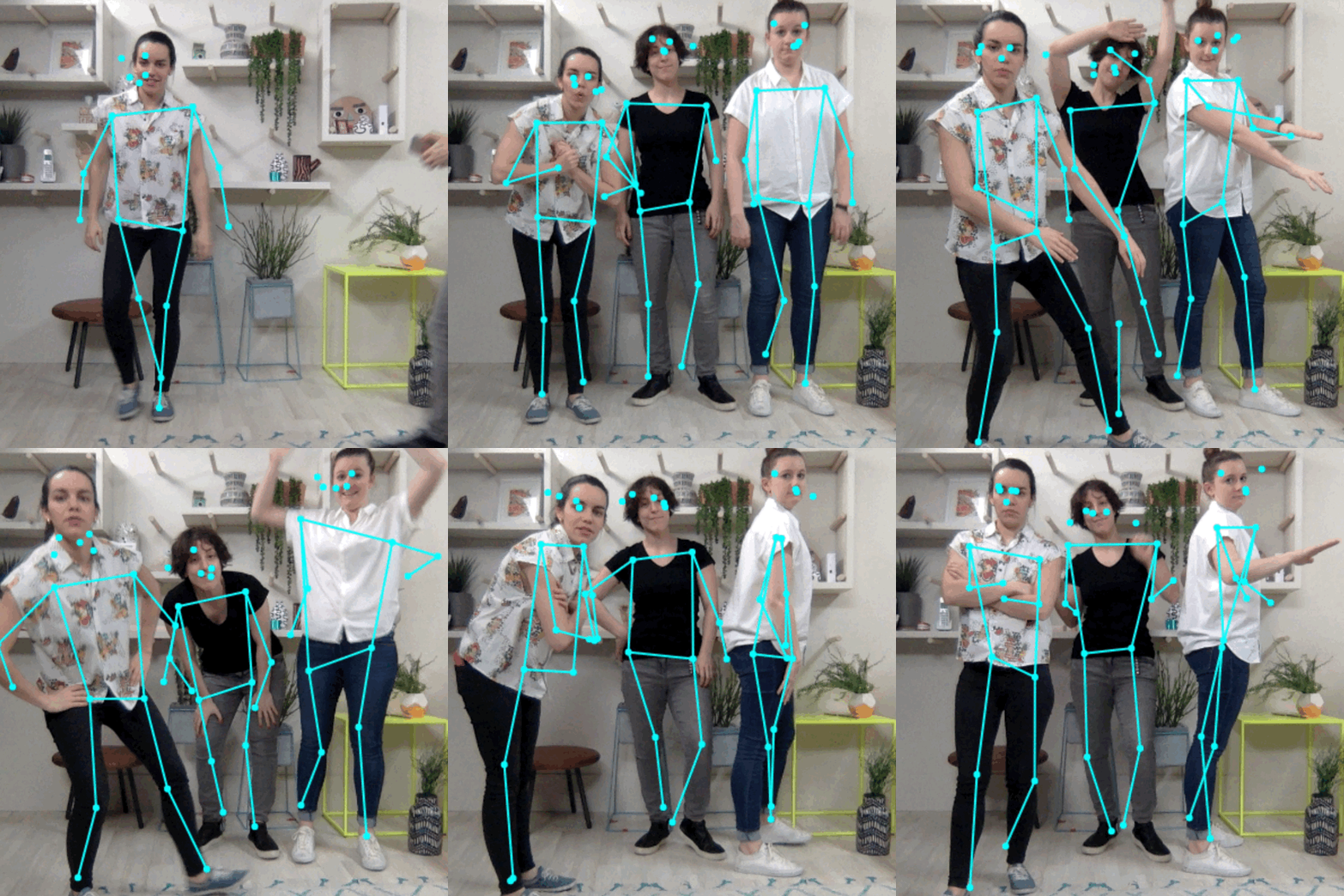
My teammates George & Tyler have been collaborating with creative technologist Dan Oved to enable realtime human pose estimation in Web browsers via the open-source Tensorflow.js (the same tech behind the aforementioned Emoji Scavenger Hunt). You can try it out here and read about the implementation details over on Medium.
Ok, and why is this exciting to begin with? Pose estimation has many uses, from interactive installations that react to the body to augmented reality, animation, fitness uses, and more. […]
With PoseNet running on TensorFlow.js anyone with a decent webcam-equipped desktop or phone can experience this technology right from within a web browser. And since we’ve open sourced the model, JavaScript developers can tinker and use this technology with just a few lines of code. What’s more, this can actually help preserve user privacy. Since PoseNet on TensorFlow.js runs in the browser, no pose data ever leaves a user’s computer.
I’m honestly not sure what to make of this wacky-looking new device, but it’s weird/interesting enough to share. I can pretty definitely say that no one wants to refocus photos/video after the fact (RIP, Lytro—and have you ever done this with an iPhone portrait image, or even known that you can?), but simply gathering depth data in 180º is interesting, as (maybe) is 360º timelapse. Check it out:
Scattered throughout the place — which seems to be a recreation of a real Oakland home — were cut-out squares floating in the air. When I hovered over them with a cursor, I saw thumbnails of photos and videos, all of which were supposedly taken in the room that I was in. When I clicked on the thumbnails, I teleported over to them so that I could see the photos and videos up close. One was a photo of a family, while another was a short video clip of a young couple getting ready for prom.
Want to “photograph an imagined cyberpunk world in-camera without any post-production”? ARwall promises you can through “a visual effects compositing technology that combines new mixed-reality screens along with the oldest (and maybe best) trick in the filmmaking book.”
This piece delves into the inception, development process, and shows the production test footage of the first ever real-time, in-camera, real-light, real-lens, perspective-adapting, mixed-reality, rear-screen, compositing technique.
The researchers tested the method with a variety of body shapes, clothing, and backgrounds and found that it had an average accuracy within 5 millimeters, they will report in June at the Computer Vision and Pattern Recognition conference in Salt Lake City. The system can also reproduce the folding and wrinkles of fabric, but it struggles with skirts and long hair. With a model of you, the researchers can change your weight, clothing, and pose—and even make you perform a perfect pirouette. No practice necessary.
Google’s Arts & Culture team partnered with CyArk to travel to over 25 sites across 18 countries, using drone imagery and 3D laser scanners to capture intricate portraits of each place. You can explore the story and 3D model of each historic location—from Syria’s Al-Azem palace, to the Temple of Eshmoun in Lebanon, to the Mayan city of Chichen Itza—on the site.
A dog (clear favorite), UFO, heart, basketball, and spider join the dinosaur, chicken, alien, gingerbread man, planet, and robot. The latter six stickers have been slightly rearranged, while the new ones are at the beginning of the carousel.
Enjoy! And let us know what else you’d like to see.
Another from the “Awesome Past Lives I Never Knew My Colleagues Had” Files: I just learned that Tarik Abdel-Gawad, with whom I’ve been collaborating on AR stuff, programmed & performed the amazing “Box” projection-mapping robot demo with Bot & Dolly before Google acquired that company. It’s now a few years old but no less stunning:
Bot & Dolly produced this work to serve as both an artistic statement and technical demonstration. It is the culmination of multiple technologies, including large scale robotics, projection mapping, and software engineering. We believe this methodology has tremendous potential to radically transform theatrical presentations, and define new genres of expression.
This super fun combo of style transfer & performance capture (see video below in case you missed the sneak peek last fall) is now accepting applications for beta testers:
Project Puppetron lets you capture your own face via webcam and, through a simple setup process, create a puppet of yourself in the style of a piece of referenced art.
[Y]ou perform various facial expressions and mouth shapes for lip sync, and then select the reference art and the level of stylization you want to apply to create a fully-realized, animated puppet.
Once Project Puppetron has created your puppet, you can perform your character or modify your puppet as you would any other puppet in Character Animator. Then, bring further dimension to your character’s performance with rigging, triggerable artwork, layer cycles, etc., through the broad array of tools offered in Character Animator.
It’s a running joke at Google that you can spend your whole career not knowing what the people nearby you are doing, or even who they are. (In fact, I continue to harbor a dream about creating an AR overlay that would solve this, but that’s another story.) As it happens, I just discovered that my teammate Bill has been making some really cool augmented reality experiments, including the open source Flight Paths:
Flight Paths is an experiment that transforms your room into a flight path visualization. Touch any horizontal surface and explore as flights take off from JFK or SFO and fly around your space. Learn more at g.co/arexperiments
Continual note to self: Ask people more about what they’re doing!
Unity integration will also allow developers to customize maps with what appears to be a great deal of flexibility and control. Things like buildings and roads are turned into objects, which developers can then tweak in the game engine. During a demonstration, Google showed off real-world maps that were transformed into sci-fi landscapes and fantasy realms, complete with dragons and treasure chests.
Jacoby says that one of the goals of the project was to help developers build detailed worlds using Maps data as a base to paint over. Developers can do things like choose particular kinds of buildings or locations — say, all stores or restaurants — and transform each one. A fantasy realm could turn all hotels into restorative inns, for instance, or anything else.
This demo of the Snappers Facial Rig is pretty damn impressive. Now, how soon until front-facing depth cameras (a la those on iPhone X) can be paired with enough on-device rendering power to produce results like this?
This app (sadly unavailable in the US, it seems) looks really creative & fun:
“To achieve a seamless transition from the TV ad to Augmented Reality we use computer vision to detect the quattro coaster TV ad. Then, we sync and position the augmented content on the screen. What’s interesting is that the car remains in the room even after the ad has ended. [more]
Judith Amores Fernandez is pursuing her PhD at MIT Media Lab & exploring new UX possibilities using Microsoft Holo Lens. Here she presents on her work with HoloARt.
This is a new media of art that explores the use of the holograms in a mixed reality, for creative self-expression. Amores Fernandez shows a video of herself using a Hololens to creates her works of art and then performs a live demonstration.
Artist Jonathan Yeo used Google Tilt Brush + 3D scanning to create his latest self-portrait, which he then cast in bronze. He tells Wired,
“It’s an incredible 3D sketch book,” says Yeo, 46. “The thing about VR that I think is really powerful is that you can draw freely in space. You don’t have to shape things like stone or clay. You can make these sweeping movements, like painting. It’s a hybrid of painting and sculpture, which is something that would have been impossible to do before.”
In this behind-the-scenes video, he explains how he used these new tools to create the sculpture.
I love it when an artistic medium reaches a level of maturity & ubiquity that we need no longer fetishize every once-novel moment (say, “Bayhem” in VFX) and instead let the expression just be (say, the realtime, brutal, almost shrugging VFX of District 9). So it is with this augmented reality sculpture project:
Re-creating performances in famous movies, capturing them with an iPhone X, and then compositing the results into those movies is, of course, 100% my kind of jam. Check out the whole thing (all great, from The Wire to Arrested Development), or just jump to the Full Metal Jacket portion.
“Have you children play in well-lit places.” It’s pretty good, if wildly impractical, advice for capturing good shots of one’s kids. I think of it now seeing this tech demo and wondering if/when/how we’ll go from capturing still images to gathering holographic captures for viewing in AR and VR.
This may be less far-fetched than it seems: A pair of ordinary cellphones might be enough to capture animated 3D representations of people.
Are Irish eyes smiling? I should ask my teammate Avneesh to scan me & find out:
Google Research presents a machine learning based approach to infer select facial action units and expressions entirely by analyzing a small part of the face while the user is engaged in a virtual reality experience. Specifically, images of the user’s eyes captured from an infrared (IR) gaze-tracking camera within a VR headset are sufficient to infer at least a subset of facial expressions without the use of any external cameras or additional sensors.
You can take in Discovery TRVLR for yourself using Google’s Daydream headset (or Google Cardboard). The show will be viewable on YouTube, DiscoveryVR.com, and on the Discovery VR app.
In La Paz, meet female wrestlers giving hope to domestic violence victims. Then cap it all off riding alongside a polar explorer through ice caves and the frozen tundra of Antarctica.
The video showcases pioneering and cutting edge technologies that enable to preserve some unique traces of this Guatemalan civilization, inherited by British explorer Alfred Maudslay.
“Teaching Google Photoshop” has been my working mantra here—i.e. getting computers to see like artists & wield their tools. A lot of that hinges upon understanding the shape & movements of the human body. Along those lines, my Google Research teammates Tyler Zhu, George Papandreou, and co. are doing cool work to estimate human poses in video. Check out the demo below, and see their poster and paper for more details.
“With Poly,” says Google AR/VR lead Clay Bavor, “our mission is to organize the world’s 3D information and make it universally accessible and useful.”
Poly lets you quickly find 3D objects and scenes for use in your apps, and it was built from the ground up with AR and VR development in mind. It’s fully integrated with Tilt Brush and Blocks, and it also allows direct OBJ file upload, so there’s lots to discover and use.
Check it out:
You’re frequently allowed to modify the models in case they don’t quite fit your needs, and you can share them as GIFs or explore them in VR viewers.
Remember Instagram hyperlapses—or if you’re nerdier, stabilization app Luma (acquired by Instagram)? Creator Alex Karpenko is back with Rylo, a $499 360º camera that promises great built-in stabilization & innovative software features. PetaPixel notes,
The second feature is called Follow, and that lets you track action with just a single tap on the app. The software will then adjust the orientation of the camera and keep the action in the frame.
Next up is Points, a feature which controls the camera’s perspective. Tapping on specific points of interest, Rylo will produce a smooth shot that “connects each of your points.”
Meanwhile Motorola has introduced the $299 moto 360 camera, a small pop-on addition to its phones that promises “360° photos and 4K video with 3D sound.” The size, immediacy of the phone connection, & ability to switch to the device’s regular cameras on the fly look pretty appealing.
Its six onboard cameras can capture VR and non-VR in 5.2K resolution, with 360-degree audio. It also has an OverCapture feature that “punches out” a regular image from a spherical photo and onboard stabilization features allow for smooth capture. The Fusion works with the GoPro app and the camera is waterproof up to 16 feet.
Back in the day Steve DiVerdi implemented 3D, physics-based brushes in Photoshop, then joined Google Photos. Now he’s back at Adobe working on VR video tech. Check out his demo of “Sidewinder,” which leverages a Google Jump VR rig to capture numerous images, then synthesize new views to enable more interactive nav (hard to describe, easy to grok when watched):
These include virtual tours of Citi Field in New York and Oriole Park at Camden Yards in Baltimore, both of which are narrated by MLB Network’s Heidi Watney. You can also get behind-the-scenes access with career tours that showcase the lives of a baseball beat reporter and television broadcasters. We’re also bringing you a Statcast tour, so you can geek out Moneyball-style with the math and physics behind the game.
Today, we’re putting that same 3D model into an experience for everyone to explore. We call it Access Mars, and it lets you see what the scientists see. Get a real look at Curiosity’s landing site and other mission sites like Pahrump Hills and Murray Buttes. Plus, JPL will continuously update the data so you can see where Curiosity has just been in the past few days or weeks. All along the way, JPL scientist Katie Stack Morgan will be your guide, explaining key points about the rover, the mission, and some of the early findings.
Curiscope takes introspection to a whole new level—and the puns’ll get under your skin:
Virtuali-Tee is a magic lens into a world inside the body. View through our free app on your phone or tablet to unlock a portal into your body’s vital organs. Jump into the pumping heart of an awesome anatomical adventure that brings learning to life in fully animated 3D using augmented and virtual reality technologies. Take a deep breath, dive into the bloodstream, and see for yourself.
Holoportation is “a new type of 3D capture technology that allows high quality 3D models of people to be reconstructed, compressed, and transmitted anywhere in the world in real-time.”
When combined with mixed reality displays such as HoloLens, this technology allows users to see and interact with remote participants in 3D as if they are actually present in their physical space. Communicating and interacting with remote users becomes as natural as face to face communication.
Creeptastic! But quick, cool, and impressive: Visit The University of Nottingham’s demo site, and check out the project site for more details. As The Verge writes,
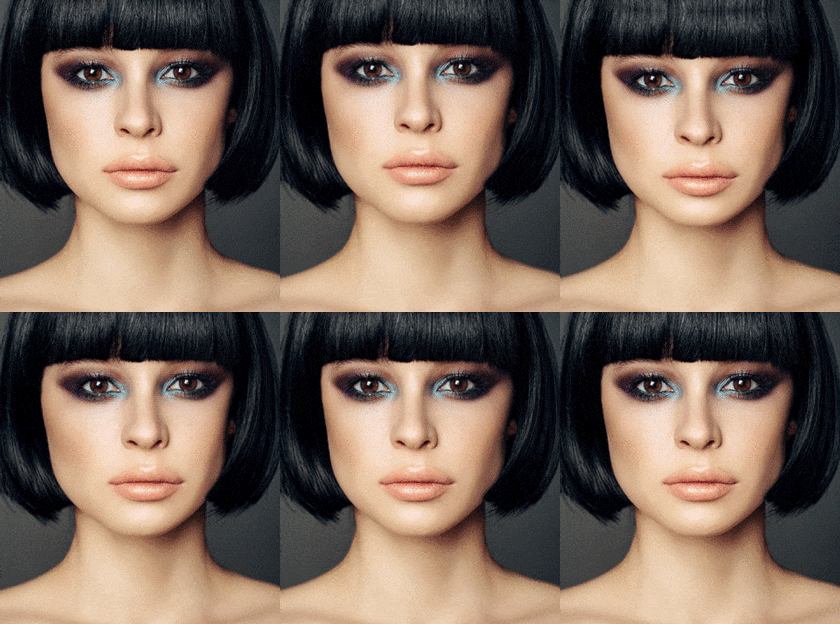
“3D face reconstruction is a fundamental computer vision problem of extraordinary difficulty.” You usually need multiple pictures of the same face from different angles in order to map every contour. But, by feeding a bunch of photographs and corresponding 3D models into a neural network, the researchers were able to teach an AI system how to quickly extrapolate the shape of a face from a single photo.
This update lets you explore Street View imagery from 85 countries right within Earth VR. Just fly down closer to street level, check your controller to see if Street View is available and enter an immersive 360° photo. You’ll find photos from the Street View team and those shared by people all around the world.
What if you could step inside a song? Inside Music is a simple experiment that explores that idea. It features the music of Phoenix, Natalia Lafourcade, Perfume Genius, Alarm Will Sound, Clipping, and Ibeyi.
if you’re a musician, you can explore your own songs in VR or put them up on the web for others to explore.
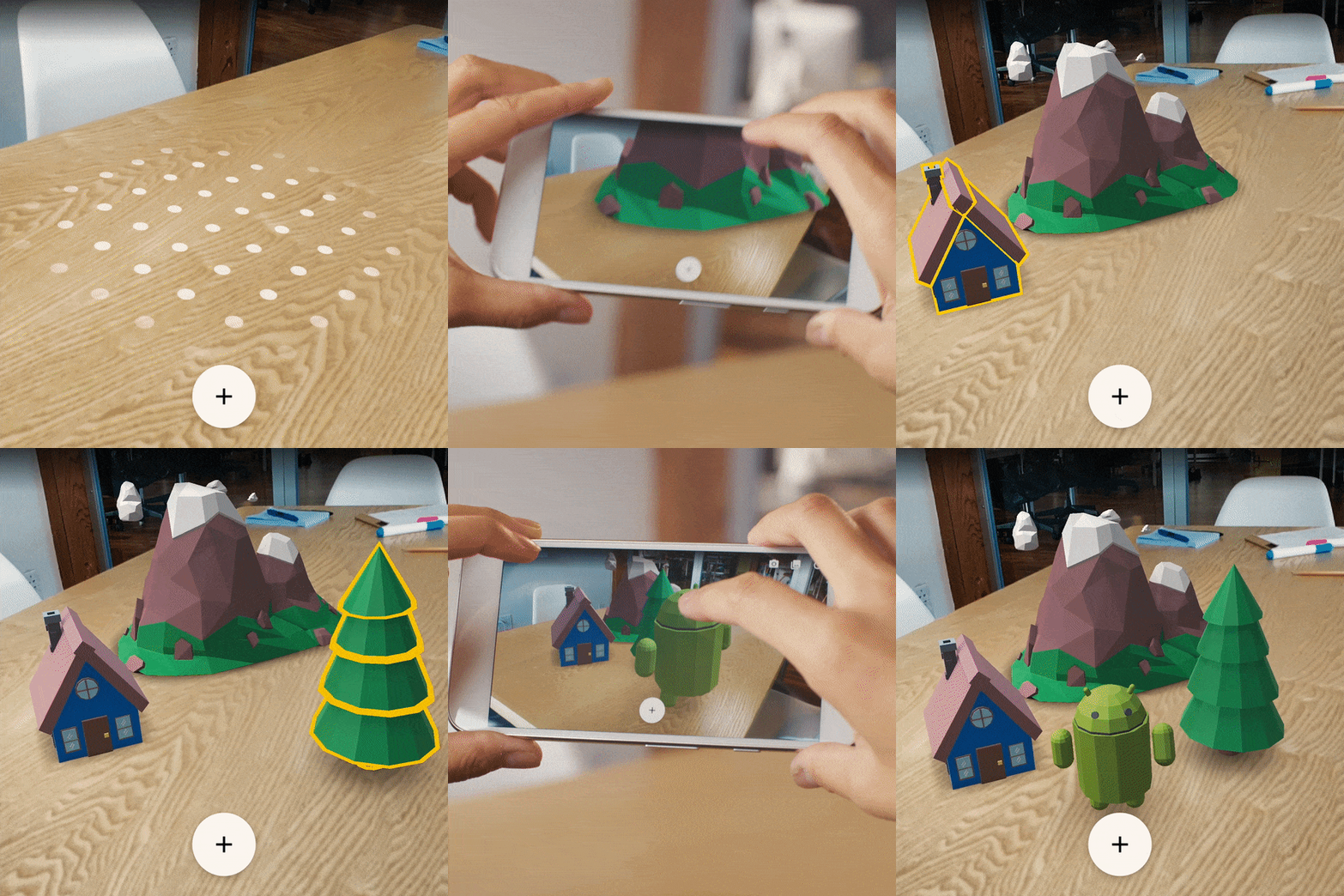
I’m delighted that Google releasing a preview SDK of ARCore, bringing augmented reality capabilities to existing and future Android phones. Developers can start experimenting with it right now.
It works without any additional hardware, which means it can scale across the Android ecosystem. ARCore will run on millions of devices, starting today with the Pixel and Samsung’s S8, running 7.0 Nougat and above. We’re targeting 100 million devices at the end of the preview.
And:
We’re also working on Visual Positioning Service (VPS), a service which will enable world scale AR experiences well beyond a tabletop. And we think the Web will be a critical component of the future of AR, so we’re also releasing prototype browsers for web developers so they can start experimenting with AR, too. These custom browsers allow developers to create AR-enhanced websites and run them on both Android/ARCore and iOS/ARKit.
Our approach is to instrument the environment leaving the user unburdened of any equipment, creating a seamless walk-up-and-play experience. We demonstrate this technology in a series of vignettes featuring humanoid animals.
Participants can not only see and hear these characters, they can also feel them on the bench through haptic feedback. Many of the characters also interact with users directly, either through speech or touch.