Monthly Archives: January 2007

Photorealistic painting; Make your own "Cars"; more

  • Artist Cali Rezo creates some beautiful, photorealistic paintings in Photoshop, as well as more stylized pieces.  She shares some behind-the-scenes snapshots, as well as a step-by-step animation of a piece coming together. [Via]
  • I Met The Walrus is an Jerry Levitan’s story of how, as a 14-year-old in 1969, he snuck into John Lennon’s hotel room & recorded an interview.  The trailer (or is it the whole film?) features some great illustrated animation.  (More on the story is here.) [Via]
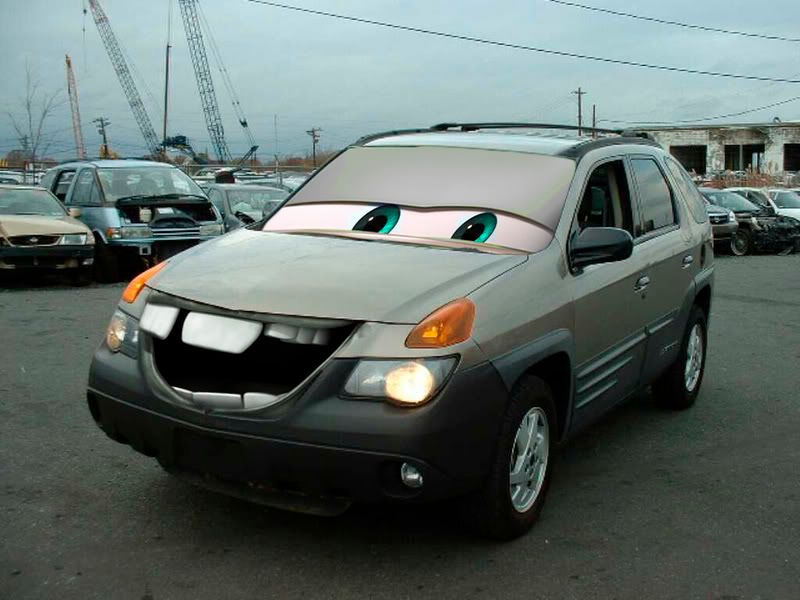
  • Make your car resemble those in "Cars" by following this tutorial.  Appropriately, a Pontiac Aztek gets a goofy, gap-toothed grin & actually looks better as a result. [Via]
  • Weirdly, I encountered the same topic on Autoblog just the next day.  They’ve posted some great examples, and now their collection of images is growing.

For more automotive rendering bits, see previous.

Photorealistic painting; Make your own "Cars"; more

  • Artist Cali Rezo creates some beautiful, photorealistic paintings in Photoshop, as well as more stylized pieces.  She shares some behind-the-scenes snapshots, as well as a step-by-step animation of a piece coming together. [Via]
  • I Met The Walrus is an Jerry Levitan’s story of how, as a 14-year-old in 1969, he snuck into John Lennon’s hotel room & recorded an interview.  The trailer (or is it the whole film?) features some great illustrated animation.  (More on the story is here.) [Via]
  • Make your car resemble those in "Cars" by following this tutorial.  Appropriately, a Pontiac Aztek gets a goofy, gap-toothed grin & actually looks better as a result. [Via]
  • Weirdly, I encountered the same topic on Autoblog just the next day.  They’ve posted some great examples, and now their collection of images is growing.

For more automotive rendering bits, see previous.

Microscopic photography; Shattered rocket

Two scientific/technical imaging entries today:

CS3 doesn't install spyware

That’s kind of a weird title, but there have been a few slightly freaked-out posts in the last couple of days suggesting that the Photoshop CS3 beta is installing spyware. The deal is that Photoshop uses Apple’s Bonjour technology to make it easy to connect to Version Cue servers.  For more details, I consulted Thomas DeMeo, Director of Product Management for the team that creates Version Cue.  Here’s what he had to say:


Adobe does not use spyware, period.
 
Since the inception of the Creative Suite (CS) family, Adobe provided a file collaboration tool with the introduction of Version Cue.  Version Cue is a file management tool that is integrated in Adobe Photoshop, Adobe InDesign, Adobe Acrobat, Adobe Illustrator and other creative applications within the Creative Suite.  It is client/server based.  The clients are integrated into each of the applications and they all communicate with the Version Cue Server.

To make setup and configuration easier, Adobe uses Apple’s Bonjour technology to enable the connectivity to Version Cue servers on a local area network. Bonjour is widely used throughout Mac OS X and Windows in applications like iTunes and popular printers to allow users to set up a network service without any configuration.

From Photoshop or Bridge you can connect to a Version Cue server without having type in a IP address. It does not enable Photoshop or Bridge to do file sharing as this is done by the Version Cue Server. It does not send information over the Internet or to Adobe. When you click on the Version Cue area in the Adobe Dialog, the Bonjour daemon running on the local machine will browse for visible Version Cue servers on your subnet. You can then log in to access the file management capabilities of the Version Cue server.

To request access to the Version Cue beta program, please contact Mike Wallen (mwallen at adobe dot com).  For more info on Bonjour, see also this Apple developer FAQ and the entry on Wikipedia.

[Update 5/11/07: I saw the following info from Timo Naroska of the Version Cue team and thought it would be worth sharing:

Bonjour sends/receives packets to the multicast IP 244.0.0.251. Routers do not forward these packets outside the local network. Furthermore Bonjour pings the local DNS server to check whether it supports service discovery.

No critical information is ever transferred.

The user should usually allow Bonjour to connect the “internet” to seamlessly browse/connect Version Cue Servers in the local network.

If the user decides to block Bonjour internet access, automatic server discovery on the local network and the local machine are hampered. The user will have to connect servers manually by IP/DNS-name.]
Yes, CS3 can be tested cross-platform

In response to very popular demand (to the tune of 150+ requests on the Labs CS3 forum), I’m happy to say that Adobe is now making it possible for Windows customers of Photoshop CS2 to get a Mac CS3 beta serial number, and vice versa.  To request a number, you can send mail to photoshopcs3beta@adobe.com & include your CS2 serial number.

We made this decision a couple weeks ago, but I didn’t want to publicize it widely until the staff was back at full strength after the holiday break. Please note that this is a manual process on our side right now, and we appreciate your patience as we handle requests.

Related: If you find that you want to switch an Adobe product license from Mac to Windows or vice versa, please contact Adobe Customer Service.  They’ll walk you through the process.

Adobe video apps: Back to the Mac

Excellent news: Last fall’s debut of the cross-platform Adobe Soundbooth beta was a sign of good things to come, and the company has just announced that the next version of the Adobe Production Studio will be available on both Macintosh & Windows. Specifics of features, pricing, and schedule aren’t being discussed right now; rather, this announcement is a heads-up that signals the direction for this tightly integrated suite of products, including a greatly increased commitment to the Mac platform.

After Effects PM Steve Kilisky has posted some background on the history & evolution of platform support in DV apps.  The short story: Adobe Premiere needed a rewrite from the ground up, so the team had to focus its efforts on a single platform, with the hope and intention of returning to the Mac after building momentum on Windows.  That’s exactly what they’re now doing, alongside Encore DVD and Soundbooth.

I know that there’s plenty of really emotional history here, and I’m posting the news just to help spread the word.  I expect that Steve, along with DV PMs Bob Donlon & Hart Shafer, will have more to say via their blogs in the weeks and months ahead.  So, I’ll leave comments open on this post, but it would probably be most useful to channel feedback to those guys directly.

[Update: Macworld has posted news and analysis of this development. I’m really pleased to see all the positive and supportive reader comments. Elsewhere, Orphanage founder Stu Maschwitz posted some brief positive notes about switching from FCP to Premiere. I love the “Voltron” comparison. :-)]

Typography laid bare

  • PingMag discusses the origins, history, and state of Iranian typography & provides numerous beautiful examples.  I dig these two in particular.
  • Taylor Lane has created a series of typographic pinups (fair warning: there’s some glyph-heavy nekkidness). [Via Marc Pawliger]
  • In an inverse vein (not pictures made from letters, but letters from pictures), Giornale Nuovo offers a brief history of figurative alphabets. [Via]
  • Joshua Smith has posted a gallery of cool type treatments (including his own logotype) on Hydro74.  The rest of his site is worth a visit for dynamite illustrations & more. [Via]
  • Type for you is a new typography blog, containing links to useful resources like Typies’ 15 tips to choose a good text type. [Via]

Mobile Flash Art: cell phone as artistic platform

Tokyo’s always interesting PingMag has posted a story discussing the way Flash Lite (the mobile device version of the Flash Player)
is enabling new kinds of pocket-sized expressiveness.  Lightweight, interactive vector art = lots o’ creative possibilities.

Necessity is the mother of invention, and designing for a small screen, low bandwidth/processor, etc. can be a fun challenge.  Some of my own favorite Web development projects involved marathon efforts to squeeze the last half-KB out of a Web banner and still have it work well (here’s a humble, 9-year-old piece for British Airways, from the pre-ImageReady/Fireworks days of DeBabelizer & GIF Builder).  The Photoshop beta includes mobile authoring hooks, and I look forward to seeing what people create with it.

Interesting (albeit unsourced) factoid from the article: "The average high-school girl in Japan spends around 15 000 yen per month for mobile content (about 99 Euro or 127 Dollars)."  So, there’s real money to be made in this market, at least in Japan.  We’ve met with designers at Disney creating mobile content for the US market, and it’ll be interesting to see how things develop here & elsewhere.

Black & White in CS3

Photoshop engineer Geoff Scott spotted a beautiful black & white image from photographer Moose Peterson, made with the help of Photoshop CS3.  (Too bad the online version isn’t larger.)   Moose writes, "I’ve always loved B&W photography but until recent developments such at the Epson 3800 and 7800 and B&W conversion in Photoshop, B&W was downright painful. With amazing paper like Epson’s UltraSmooth Fine Art and the ease of B&W conversion in CS3, why wouldn’t someone enjoy the amazing old art of B&W photography."

For more info, check out Russell Brown’s 4-minute video intro to the Black & White dialog, where he shows off the ability to click and drag on color regions to adjust them, as well as a technique for hand-tinting the results.  Russell produced some great B&W presets for Camera Raw in CS2, so I’m sure he’ll offer more good info, tips, and settings for the much-improved B&W controls in CS3’s Camera Raw 4.0.  I had fun using the new split toning functions, together with Photoshop’s venerable Lighting Effects dialog, to show my wife contemplating a "Portrait of the Governor as a Young Man" on New Year’s Eve. (It was a weird party. ;-))

Black & White in CS3

Photoshop engineer Geoff Scott spotted a beautiful black & white image from photographer Moose Peterson, made with the help of Photoshop CS3.  (Too bad the online version isn’t larger.)   Moose writes, "I’ve always loved B&W photography but until recent developments such at the Epson 3800 and 7800 and B&W conversion in Photoshop, B&W was downright painful. With amazing paper like Epson’s UltraSmooth Fine Art and the ease of B&W conversion in CS3, why wouldn’t someone enjoy the amazing old art of B&W photography."

For more info, check out Russell Brown’s 4-minute video intro to the Black & White dialog, where he shows off the ability to click and drag on color regions to adjust them, as well as a technique for hand-tinting the results.  Russell produced some great B&W presets for Camera Raw in CS2, so I’m sure he’ll offer more good info, tips, and settings for the much-improved B&W controls in CS3’s Camera Raw 4.0.  I had fun using the new split toning functions, together with Photoshop’s venerable Lighting Effects dialog, to show my wife contemplating a "Portrait of the Governor as a Young Man" on New Year’s Eve. (It was a weird party. ;-))

Photography to welcome a new year

  • Milk’shroom: From Germany comes a terrific image of milk dropping into coffee. [Via]
  • Like perhaps millions of others, I’ve seen some of Steve McCurry‘s famous and arresting images, but like many I didn’t know his name.  I know it now, as the always-excellent blog The Online Photographer highlighted the arrival of Looking East, a book of Steve’s portraiture. Do be careful, though: his site contains a rich portfolio and could well suck you in for ages (and it did me). [Via]
  • Through T.O.P. I was reminded of the work of Jill Greenberg, whom they’ve named Photographer of the Year.  Her crying tots aren’t my cup of tea, but for whatever reason I really groove on her monkey portraits. See more of them here.
  • My own amateurish bits suffer by proximity, but the windy CA weather dropped a few groovy branches in our yard last night, and with a macro lens borrowed from the ‘Dobe, I had fun creating a few shots.  I’ve posted them (1, 2) via Zoomify, exported from CS3, as well so you can see the details. [Note: We’ll fix that "zoomed way out by default" bug soon, I promise.]
  • Someday, I’m afraid, you’ll read that I crashed and burned on Hwy 101 while transfixed by the comings & goings at Moffett Field, former home of the Navy’s lighter-than-air fleet.  In the meantime, the NYT is selling a beautiful print of a Zeppelin over Manhattan. On a related note, "Personal Blimp" refers not just to a product mgr. stuffed with HoneyBaked Ham (it was delicious) , but also to a small new airship being designed in Massachusetts. [Via]

Oh, and by the way, Happy New Year! 🙂