Sometimes the simplest things are the most charming & amazing. Days of miracles & wonder, man.
For more fun examples follow @MadeWithARKit on Twitter.
[YouTube]
Sometimes the simplest things are the most charming & amazing. Days of miracles & wonder, man.
For more fun examples follow @MadeWithARKit on Twitter.
[YouTube]
Great Gaia! Take Elizabeth Edwards’s drawing for a spin, and check out her other 3D work made using Google Tilt Brush.

Google’s VR paint experience Tilt Brush just got a hefty update with a slew of new features that let users tweak the environment for more dynamic lighting and color options. But even more exciting: The community is getting its own social website where they can upload their art for others to download and remix themselves.
Check it out:
REEEMIX! Share your sketches to https://t.co/4IeS4gGgCQ and discover and remix shared artwork in the latest #TiltBrush update. pic.twitter.com/bRxRv6nUxY
— Tilt Brush (@tiltbrush) April 27, 2017

This monster features 17 4k cameras (!) backed by cloud compute:
Footage from those cameras runs through the Jump Assembler, which uses sophisticated computer vision algorithms and the computing power of Google’s data centers to create 3D 360 video. Amazing VR videos have been made with Jump, such as The New York Times’ Great Performers collection, Within’s “The Possible” series, the NFL Immersed series, and Wevr’s “Internet Surfer” video.

Google is looking to sponsor 100 filmmakers (you?) to use it to make epic stuff:
Jump Start gives selected filmmakers both free access to a Jump camera and free unlimited use of the Jump Assembler for their VR film. Over the next year, the program will give over 100 creators these tools and enable them to make their vision a reality. Applications to Jump Start open today, and filmmakers have until May 22nd to apply.
[YouTube]
I gave up my first career as a Web animator/designer & joined Adobe specifically to build out Web standards (SVG back then) and the tools that could push & leverage them. Thus my old grinch-heart grows three sizes seeing the development of WebVR & fun experiments that show it off:

[YouTube]
Check out how the Peer concept aims to make abstract concepts tangible for kids:
Fast Company writes,
A lesson in aerodynamics, for instance, would start when students strap on a VR headset, like Google Cardboard or Daydream. Their teacher could then demonstrate how aerodynamics works in mixed reality before the kids remove their headsets and get to work designing windmill arms, working with their hands to create something they think will generate the most wind speed. Then, on goes the headset again. As students begin testing their windmills with a fan, embedded sensors in the windmill spindle record rotational speed, and the headset shows the students the speed of their mills.
Moment’s John Payne says,
“VR is often simply reduced to a storytelling medium, but we believed it could be used in a more integrated way with the real-world environment, more as a ‘tool’ than as an ‘experience.'”
It’s undoubtedly cool, and I’d love to see how students and teachers can put it to use. And beyond that, I’d love to see the tools that’d make it possible for thousands of other lessons (needed to fit a wide range of curricula) to be made in an economically sustainable way.
I’d characterize my outlook at guardedly optimistic. I’m reminded me of when CD-ROM based magazines arrived, and then when tablet-based magazines repeated the whole fantasy of “Now everyone will build/pay for rich, interactive 3D content!” They even debuted with a 3D windmill, for God’s sake. Of course the world moved differently, voting with its feet more for Snapchat stories (crude assemblies of unedited clips, shat out even by well funded orgs like the NYT) than for highly polished, immersive creations.
And yet hope dies last, and all of us toolmakers have the privilege of trying to rebalance the scales. If it weren’t hard, it probably wouldn’t be fun. 🙂

iPad + strapped-on Vive controller = realtime shot-composing! Check out these interesting homebrew tools:
Kottke writes,
In this video, we see a couple more tools the team used to facilitate the making of the film. The first is a VR video game of sorts that ILM built so that Edwards could move a virtual camera around in a virtual set to find just the right camera angles to capture the action, resulting in a process that was more flexible than traditional storyboarding.
The second tool jumped around a virtual set — a complete digital model of Jedha City — and rendered hundreds of street views from it at random. Then the filmmakers would look through the scenes for interesting shots and found scenes that looked more “natural” than something a digital effects artist might have come up with on purpose — basically massively parallel location scouting.

[YouTube]
This is bonkers: By having your face 3D scanned, you can now have it show through a VR headset (complete with moving, blinking eyes!), like this:
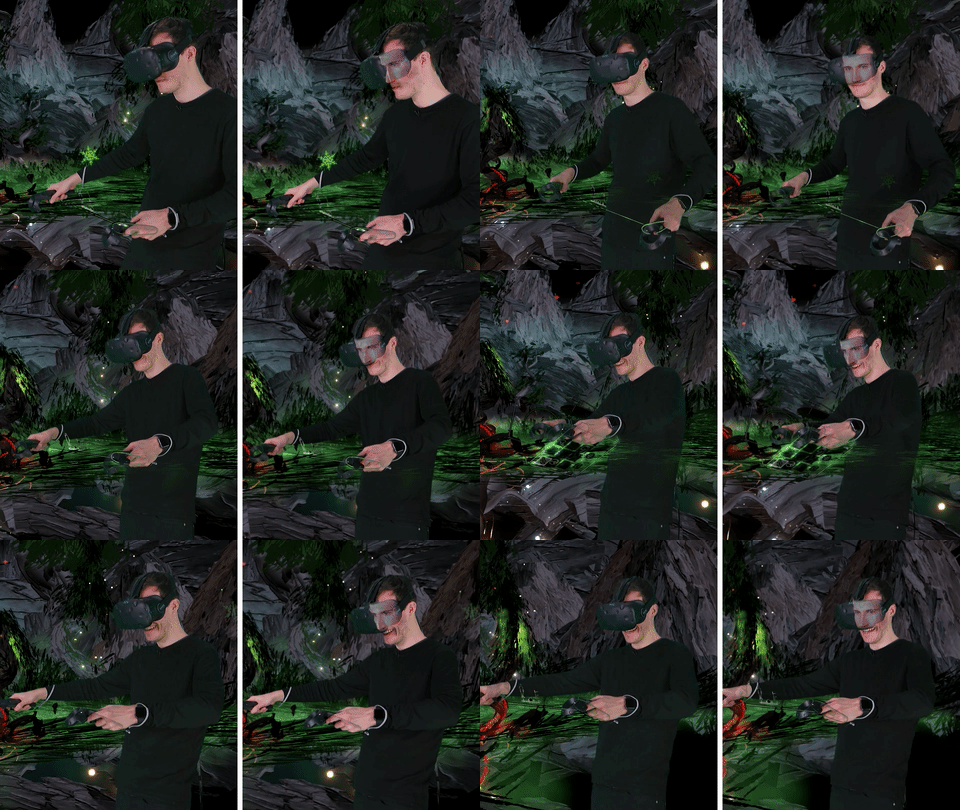
The Daydream VR team explains,
The first step to removing the VR headset is to construct a dynamic 3D model of the person’s face, capturing facial variations as they blink or look in different directions. This model allows us to mimic where the person is looking, even though it’s hidden under the headset.
Next, we use an HTC Vive, modified by SMI to include eye-tracking, to capture the person’s eye-gaze from inside the headset. From there, we create the illusion of the person’s face by aligning and blending the 3D face model with a camera’s video stream. A translucent “scuba mask” look helps avoid an “uncanny valley” effect.
For a really funny tour, check out the Try Guys’ adventures in VR:

[YouTube]
Heh—Team Coco in the floating, glowing house! I’ll let Conan serve up the funny from here:

[YouTube]
It’s easy to pooh-pooh VR (believe me, I’ve bagged on plenty of examples), but this bit of immersive telepresence is pretty special:
Forbes explains,
Using satellite technology, 360-degree immersive pods and the filmmaking direction of Peter Berg, Hyundai… showed the soldiers experiencing a kind of virtual reality: that they were in Houston watching the Big Game live in a suite on site. But the shocker at the end and shown live just after the game was when it was revealed that—in a twist on the classic soldier-surprises-family—their loved ones were in the suite to surprise them.
Footage from Houston and Poland was edited and produced in a production trailer outside the stadium during the game.

[YouTube]
Google’s Cultural Institute has teamed up with artists to celebrate the Lunar New Year with arts and crafts from East Asia. Check out beautiful brushing traditions given new dimension—literally—in Tilt Brush:
Tyrsa and Yué Wu collaborated on a unique artwork in virtual reality mixing Chinese traditional characters and English language to celebrate the Lunar New Year.

[YouTube]
I see stuff like this & think, “It’s pretty clear I’m wasting my life.” How am I not working directly to help artists create next-gen radness? Check out what a diverse set of creators, from graffiti artists to New Yorker stalwart Roz Chast, can do in 3D space:
Google has been working closely with more than 60 artists to help them explore their style in virtual reality as part of the Tilt Brush Artist in Residence program (AiR). Coming from a wide range of disciplines, these graffiti artists, painters, illustrators, graphic designers, dancers, concept artists, creative technologists and cartoonists have all brought their passion and talent to create some amazing art with Tilt Brush.


[YouTube]
Combinatoric artistic powers, activate!
Today, we’re introducing the Tilt Brush Toolkit, an open source library for bringing your Tilt Brush art to other creative projects. With the toolkit, the next generation of artists can create narrative, interactive, and immersive content using Tilt Brush sketches.

[YouTube]
Physics-based space simulator Universe Sandbox² looks pretty badass, merging “gravity, climate, collision, and material interactions to reveal the beauty of our universe and the fragility of our planet. Create, destroy, and interact on a scale you’ve never before imagined.”


[YouTube] [Via Brian Maffitt]
These are wonder years indeed. The Mathematician Formerly Known As Winnie Cooper demonstrates writing equations in virtual reality space:
That’s novel, but is it useful? Apparently so: Using the collaborative mode Tilt Brush, student John Sterling McGregor is learning calculus with others using Tilt Brush in VR with the HTC Vive. Here’s an example:
So, what does all this mean? Will it be useful & transformative, or is it just Centrifugal Bumble-Puppy? I’m eager to see.

[YouTube]
I love the idea of easily placing photo objects in space, getting a feel for what’s possible:
From the designers at Artefact, Storyboard VR is a prototyping and visualization tool that helps content creators, artists and designers use their existing skills to imagine and visualize VR experiences, no development tools or skills required.

[Vimeo]
Hmm—this Frankenhelmet is, well, aesthetically questionable, but I’d love to take it for a spin:
Bridge is a VR & Mixed Reality headset made specifically for iPhone. It brings positional tracking and obstacle avoidance to VR with a Unity plugin, and full mixed reality, where characters blend into the real world around you

[YouTube]
“Why doesn’t designing feel like dancing?” I used to ask Photoshop teammates. Then they’d stare back blankly and I’d say, “Yeah yeah—crack don’t smoke itself…”
But here’s to the crazy ones, and Erik Natzke’s work has long inspired me. Seeing a talk of his years ago, in which he showed how he’d build custom interfaces in Flash that let other artists customize images & animation, sent me on a years-long inquiry into what could happen if Flash or HTML were a layer type in Adobe apps. The point is, he tends to open eyes & get juices flowing.
Thus I’m excited to see Erik & co. working on “Project Dali”:
Erik writes,
I don’t think of Project Dali as digital or analog. It’s something that mixes the two and comes out completely unique. It could incorporate texture (think of the exquisite feel of graphite) and time (your paint is drying) with the unending flexibility of digital. It takes art that used to feel static and lets us manipulate it in three-dimensional space. In the process, the art becomes different, magical.
I’m starting to think about it like a musical instrument: If you are a musician, your instrument enables your creativity; it doesn’t stand between you and the idea in your head. And just like with VR, you learn by playing.
I can’t wait to take it for a spin & see how it evolves.

[YouTube]
This looks totally bananas:
Ten years ago, Google Earth began as an effort to help people everywhere explore our planet. And now, with more than two billion downloads, many have. Today, we are introducing Google Earth VR as our next step to help the world see the world. With Earth VR, you can fly over a city, stand at the top of the highest peaks, and even soar into space.
You can grab it now for the HTC Vive.

[YouTube]
I’d love to experience a next-gen Awesome; I Fuckin’ Shot That! as a series of 360º video bubbles that I can jump among (landing on stage, in the crowd, etc.). (Ah, but can I get Moby Dick there?)
The team writes,
This new standalone app was built from the ground up and optimized for VR. You just need a Daydream-ready phone like Pixel and the new Daydream View headset and controller to get started. Every single video on the platform becomes an immersive VR experience, from 360-degree videos that let you step inside the content to standard videos shown on a virtual movie screen in the new theater mode. The app even includes some familiar features like voice search and a signed in experience so you can follow the channels you subscribe to, check out your playlists and more.

