Artist & musician Ben Morin has been making some impressive pop-culture mashups, turning well-known characters into babies (using, I believe, Midjourney to combine a reference image with a prompt). Check out the results.

Artist & musician Ben Morin has been making some impressive pop-culture mashups, turning well-known characters into babies (using, I believe, Midjourney to combine a reference image with a prompt). Check out the results.
Happy Friday. 🫧
Our friend Christian Cantrell (20-year Adobe vet, now VP of Product at Stability.ai) continues his invaluable world to plug the world of generative imaging directly into Photoshop. Check out the latest, available for free here:
It’s insane to me how much these emerging tools democratize storytelling idioms—and then take them far beyond previous limits. Recently Karen X. Cheng & co. created some wild “drone” footage simply by capturing handheld footage with a smartphone:
Now they’re creating an amazing dolly zoom effect, again using just a phone. (Click through to the thread if you’d like details on how the footage was (very simply) captured.)
Meanwhile, here’s a deeper dive on NeRF and how it’s different from “traditional” photogrammetry (e.g. in capturing reflective surfaces):
Check out the latest magic, as described by Gizmodo:
To make an age-altering AI tool that was ready for the demands of Hollywood and flexible enough to work on moving footage or shots where an actor isn’t always looking directly at the camera, Disney’s researchers, as detailed in a recently published paper, first created a database of thousands of randomly generated synthetic faces. Existing machine learning aging tools were then used to age and de-age these thousands of non-existent test subjects, and those results were then used to train a new neural network called FRAN (face re-aging network).
When FRAN is fed an input headshot, instead of generating an altered headshot, it predicts what parts of the face would be altered by age, such as the addition or removal of wrinkles, and those results are then layered over the original face as an extra channel of added visual information. This approach accurately preserves the performer’s appearance and identity, even when their head is moving, when their face is looking around, or when the lighting conditions in a shot change over time. It also allows the AI generated changes to be adjusted and tweaked by an artist, which is an important part of VFX work: making the alterations perfectly blend back into a shot so the changes are invisible to an audience.
As I say, another day, another specialized application of algorithmic fine-tuning. Per Vice:
For $19, a service called PhotoAI will use 12-20 of your mediocre, poorly-lit selfies to generate a batch of fake photos specially tailored to the style or platform of your choosing. The results speak to an AI trend that seems to regularly jump the shark: A “LinkedIn” package will generate photos of you wearing a suit or business attire…

…while the “Tinder” setting promises to make you “the best you’ve ever looked”—which apparently means making you into an algorithmically beefed-up dudebro with sunglasses.
Meanwhile, the quality of generated faces continues to improve at a blistering pace:
✨ Trained my own model for https://t.co/ll0YGEo53Z for more photorealistic renders called
`people-diffusion`
I think by this week I can deploy it!
🤖 These are all 100% AI-generated people
Skin finally has pores now but don’t look at the hands yet please 😂 pic.twitter.com/Y6wbPz3BSS
— @levelsio (@levelsio) November 21, 2022
Hah—check out this #ChatGPT discovery by Howard Pinsky:
Oh my gosh it just got better. I now asked it to write a ‘snarky’ tutorial on the Pen Tool. 😂 pic.twitter.com/PpuXZVscZx
— Howard Pinsky (@Pinsky) December 1, 2022
The Doggfather recently shared a picture of himself (rendered presumably via some Stable Diffusion/DreamBooth personalization instance)…
…thus inducing fans to reply with their own variations (click tweet above to see the thread). Among the many fun Snoop Doggs (or is it Snoops Dogg?), I’m partial to Cyberpunk…
Cyberpunk Snoop Dogg, 1,2,3 or 4? pic.twitter.com/w8BgeJBx86
— Techietree.eth/tez (@techietree_eth) November 29, 2022
…and Yodogg:
Yodogg pic.twitter.com/9qqbluoCyt
— NIDO (@OfficialNID0) November 28, 2022
Great work from Guy Parsons, combining Midjourney with Capcut:
And from the replies, here’s another fun set:
Thanks!!! Turned my bernedoodle puppy into a ‘90s Disney movie promo with this. Hahah pic.twitter.com/ShakTS4E6t
— Spencer Albers (@SpencerAlbers) November 28, 2022
I meant to share this one last month, but there’s just no keeping up with the pace of progress!
My initial results are on the uncanny side, but more skillful practitioners like Paul Trillo have been putting the tech to impressive use:
Among the many, many things for which I can give thanks this year, I want to express my still-gobsmacked appreciation of the academic & developer communities that have brought us this year’s revolution in generative imaging. One of those developers is our friend & Adobe veteran Christian Cantrell, and he continues to integrate new tech from his new company (Stability AI) into Photoshop at a breakneck pace. Here’s the latest:
Here he provides a quick comparison between results from the previous Stable Diffusion inpainting model (top) & the latest one:

In any event, wherever you are & however you celebrate (or don’t), I hope you’re well. Thanks for reading, and I wish all the best for the coming year!
Among the great pleasures of this year’s revolutions in AI imaging has been the chance to discover & connect with myriad amazing artists & technologists. I’ve admired the work of Nathan Shipley, so I was delighted to connect him with my self-described “grand-mentee” Joanne Jang, PM for DALL•E. Nathan & his team collaborated with the Dalí Museum & OpenAI to launch Dream Tapestry, a collaborative realtime art-making experience.
The Dream Tapestry allows visitors to create original, realistic Dream Paintings from a text description. Then, it stitches a visitor’s Dream Painting together with five other visitors’ paintings, filling in the spaces between them to generate one collective Dream Tapestry. The result is an ever-growing series of entirely original Dream Tapestries, exhibited on the walls of the museum.
Check it out:
Another day, another special-purpose variant of AI image generation.
A couple of years ago, MyHeritage struck a chord with the world via Deep Nostalgia, an online app that could animate the faces of one’s long-lost ancestors. In reality it could animate just about any face in a photo, but I give them tons of credit for framing the tech in a really emotionally resonant way. It offered not a random capability, but rather a magical window into one’s roots.
Now the company is licensing tech from Astria, which itself builds on Stable Diffusion & Google Research’s DreamBooth paper. Check it out:

Interestingly (perhaps only to me), it’s been hard for MyHeritage to sustain the kind of buzz generated by Deep Nostalgia. They later introduced the much more ambitious DeepStory, which lets you literally put words in your ancestors’ mouths. That seems not to have bent the overall needle in awareness, at least in the way that the earlier offering did. Let’s see how portrait generation fares.

Speaking of Bilawal, and in the vein of the PetPortrait.ai service I mentioned last week, here’s a fun little video in which he’s trained an AI model to create images of his mom’s dog. “Oreo lookin’ FESTIVE in that sweater, yo!” 🥰 I can only imagine that this kind of thing will become mainstream quickly.
Last year my friend Bilawal Singh Sidhu, a PM driving 3D experiences for Google Maps/Earth, created an amazing 3D render (also available in galactic core form) of me sitting atop the Trona Pinnacles. At that time he used “traditional” photogrammetry techniques (kind of a funny thing to say about an emerging field that remains new to the world), and this year he tried processing the same footage (comprised of a couple simple orbits from my drone) using new Neural Radiance Field (“NeRF”) tech:
For comparison, here’s the 3D model generated via the photogrammetry approach:
The file is big enough that I’ve had some trouble loading it on my iPhone. If that affects you as well, check out this quick screen recording:
A new (to me, at least) group called Kive has just introduced AI Canvas.

Here’s a quick demo:
To my eye it’s similar to Prompt.ist, introduced a couple of weeks ago by Facet:
I’m curious: Have you checked out these tools, and do you intend to put them to use in your creative processes? I have some thoughts that I can share soon, but in the meantime it’d be great to hear yours.
I’m not sure whom to credit with this impressive work (found here), nor how exactly they made it, but—like the bespoke pet portraits site I shared yesterday—I expect to see an explosion in such purpose-oriented applications of AI imaging:

We’re at just the start of what I expect to be an explosion of hyper-specific offerings powered by AI.
For $24, PetPortrait.ai offers “40 high resolution, beautiful, one-of-a-kind portraits of your pets in a variety of styles.” They say it takes 4-6 hours and requires the following input:
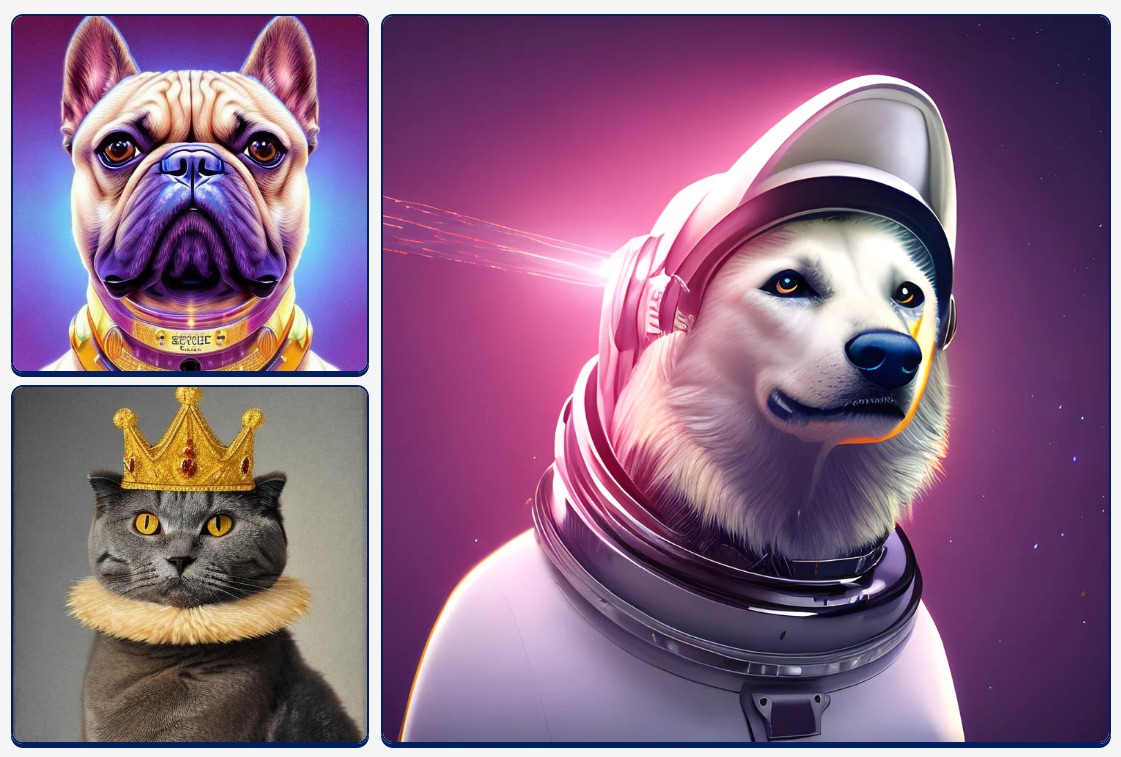
It’ll be interesting to see what kind of traction this gets. The service Turn Me Royal offers more human-made offerings in a similar vein, and we delighted our son by commissioning this doge-as-Venetian-doge portrait (via an artist on Etsy) a couple of years ago:


I had the chance to grab breakfast with Figma founder & CEO Dylan Field a couple of weeks ago, and I found him to be incredibly modest and down to earth. He reminded me of certain fellow Brown CS majors—the brilliant & gracious founding team of Adobe After Effects. I can’t wait for them all to meet someday soon.
In any case, I really enjoyed the hour-long interview Dylan did with Nilay Patel of The Verge. Here’s hoping that the Adobe deal goes through as planned & that we get to do great things together!
A few weeks ago I shared info on Google’s “Infinite Nature” tech for generating eye-popping fly-throughs from still images. Now that team has shared various interesting tech details on how it all works. And if reading all that isn’t your bag, hey, at least enjoy some beautiful results:

At Adobe MAX a couple of weeks ago, the company offered a sneak peek of editable type in Adobe Express being rendered via a generative model:
That sort of approach could pair amazingly with this sort of Midjourney output:
I’m not working on such efforts & am not making an explicit link between the two—but broadly speaking, I find the intersection of such primitives/techniques to be really promising.
Check out explanation below, then start creating right here.
Christian Cantrell’s back & killing it as usual with the new version of his free Photoshop plugin:
He notes, “Custom, fine-tuned models are absolutely game-changing, and in the future will almost certainly represent the majority of diffusion-based creativity.” 👀 Seems like a non-trivial statement coming from the new VP of product at Stability.ai.
The 3D and Immersive Design Team at Adobe is looking for a design intern who will help envision and build the future of Adobe’s 3D and MR creative tools.
With the Adobe Substance 3D Collection and Adobe Aero, we’re making big moves in 3D, but it is still early days! This is a huge opportunity space to shape the future of 3D and AR at Adobe. We believe that tools shape our world, and by building the tools that power 3D creativity we can have an outsized impact on our world.
As I may have mentioned, my 13yo son Henry—lover of all things vintage & (often) arcane—has recently taken a real interest in typography. We both enjoyed this short love letter to the craft of typesetting & printing:
I haven’t yet gotten to try this integration, but I’m excited to see it arrive.
Check out this cool little workflow from Sergei Galkin:
It uses Mixamo specifically for auto-rigging:

I’ve tried it & it’s pretty slick. These guys are cooking with gas! (Also, how utterly insane would this have been to see even six months ago?! What a year, what a world.)
Happy day to all who celebrate. 😌
The whole thread is hilarious & well worth a look:
Man, I can’t keep up with this stuff—and that’s a great problem to have. Here are some interesting finds from just the last few days:
You can take Maverick out of the Tomcat, but you can’t take the tom cat out of Maverick. 😸
[Via CAPT Chris Peppel, USN]
98% unrelated, but possibly amusing:
I always enjoy this kind of quick peek behind the scenes:
OMG—interactive 3D shadow casting in 2D photos FTW! 🔥
In this sneak, we re-imagine what image editing would look like if we used Adobe Sensei-powered technologies to understand the 3D space of a scene – the geometry of a road and the car on the road, and the trees surrounding, the lighting coming from the sun and the sky, the interactions between all these objects leading to occlusions and shadows – from a single 2D photograph.
One of the sleeper features that debuted at Adobe MAX is the new Create Background, found under Neural Filters. (Note that you need to be running the current public beta release of Photoshop, available via the Creative Cloud app—y’know, that little “Cc” icon dealio you ignore in your menu bar. 🙃)
As this quick vid demonstrates, the filter can not only generate backgrounds based on text, it links to a Behance gallery containing images and popular prompts. You can use these visuals as inspiration, then use the prompts to produce artwork within the plugin:
Here’s the Behance browser:

I’m really excited to learn more about this development, which I’ve been eagerly awaiting. More control + more speed will make generative imaging truly, broadly useful. I’d like to understand how it compares to techniques like prompt editing.
Here’s a nice three-minute overview:
Motion Library allows you to easily add premade animated motions like fighting, dancing, and running to your characters. Choose from a collection of over 350 motions and watch your puppets come to life in new and exciting ways!
The Lightroom team has rolled out a ton of new functionality, from smarter selections to adaptive presets to performance improvements. You should read up on the whole shebang—but for a top-level look, spend a minute with Ben Warde:
And looking a bit more to the future, here’s a glimpse at how generative imaging (in the style of DALL•E, Stable Diffusion, et al) might come into LR. Feedback & ideas welcome!
Check out my teammates’ new explorations, demoed here on Adobe Express:
Can’t wait for generative AI + editable text in Adobe tools! 🤖🔥 pic.twitter.com/2kZi4rYM21
— John Nack (@jnack) October 19, 2022
Per the blog post:
Generative AI incorporated into Adobe Express will help less experienced creators achieve their unique goals. Rather than having to find a pre-made template to start a project with, Express users could generate a template through a prompt, and use Generative AI to add an object to the scene, or create a unique font based on their description. But they still will have full control — they can use all of the Adobe Express tools for editing images, changing colors, and adding fonts to create the flyer, poster, or social media post they imagine.
LatentSpace.dev promises to turn your images into text prompts that can be used in Stable Diffusion to create new artwork. Watch it work:
It interpreted a pic of my old whip as being, among other things, a “5. 1975 pontiac firebird shooting brake wagon estate.” Not entirely bad! 😌

It seems almost too good to be true, but Google Researchers & their university collaborators have unveiled a way to edit images using just text:

In this paper we demonstrate, for the very first time, the ability to apply complex (e.g., non-rigid) text-guided semantic edits to a single real image. For example, we can change the posture and composition of one or multiple objects inside an image, while preserving its original characteristics. Our method can make a standing dog sit down or jump, cause a bird to spread its wings, etc. — each within its single high-resolution natural image provided by the user.

Contrary to previous work, our proposed method requires only a single input image and a target text (the desired edit). It operates on real images, and does not require any additional inputs (such as image masks or additional views of the object).

I can’t wait to see it in action!
Back at the start of my DALL•E journey, I wished aloud for a diffusion-powered mobile app:
Now, thanks to the openness of Stable Diffusion & WebAR, creators are bringing that vision closer to reality:
I can’t wait to see what’s next!
Easy placement/movement of 3D primitives -> realistic/illustrative rendering has long struck me as extremely promising. Using tech like StyleGAN to render from 3D can produce interesting results, but it’s been difficult to bring the level of quality & consistency up to what Adobe users demand.
Now with Stable Diffusion (and, one hopes, other diffusion models in the future) attached to Blender (and, one hopes, other object manipulation tools), the vision is getting closer to reality:
Check out a fun historical find from Adobe evangelist Paul Trani:
The video below shipped on VHS with the very first version of Adobe Illustrator. Adobe CEO & Illustrator developer John Warnock demonstrated the new product in a single one-hour take. He was certainly qualified, being one of the four developers whose names were listed on the splash screen!
How lucky it was for the world that a brilliant graphics engineer (John) married a graphic designer (Marva Warnock) who could provide constant input as this groundbreaking app took shape.
If you’re interested in more of the app’s rich history, check out The Adobe Illustrator Story:
The power & immersiveness of rendering 3D from images is growing at an extraordinary rate. NeRF Studio promises to make creation much more approachable:
The kind of results one can generate from just a series of photos or video frames is truly bonkers:
Here’s a tutorial on how to use it:
Check out Christian Cantrell’s latest work (still free!):
Check out Palette:
Here’s another beautiful, DALL•E-infused collaboration between VFX whiz Paul Trillo & Shyama Golden:
“My whole life has been one long ultraviolent hyperkinetic nightmare,” wrote Mark Leyner in “Et Tu, Babe?” That thought comes to mind when glimpsing this short film by Adam Chitayat, stitched together from thousands of Street View images (see Vimeo page for a list of locations).
I love the idea—indeed, back in 2014 I tried to get Google Photos to stitch together visual segues that could interconnect one’s photos—but the pacing here has my old man brain pulling the e-brake after just some short exposure. YMMV, so here ya go:
[Via]
